
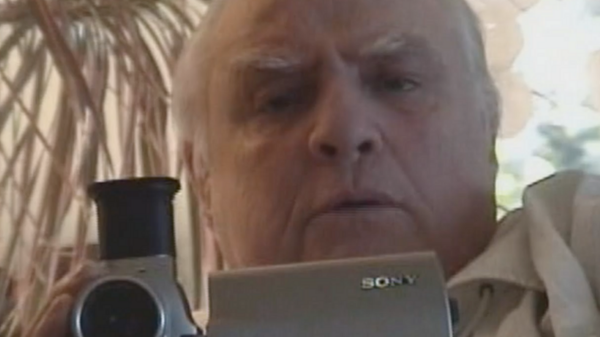
Tony Kaye’s documentary Humpty Dumpty X takes a bitter look back at a notorious feud with the Directors Guild of America and New Line Cinema. The filmmaker sought to remove his name from a cut of his 1998 film American History X that he did not approve of and replace it with Humpty Dumpty instead of the go-to name of Alan Smithee. The final cut was supposedly largely overseen by its star, Edward Norton.
Kaye’s camcorder footage reveals a Hollywood that, in some ways, still feels similar today (including the crass commercialism of the then-new Jurassic Park ride at Universal Studios, glimpsed on a passing billboard). At one point, Kaye converses with director Mike Figgis, who had recently been nominated for an Academy Award for Leaving Las Vegas. Figgis talks about surviving the industry, basically boiling his advice down to keeping one’s mouth shut and enduring the abuse.
Kaye does the opposite—bold, brazen, with a bloated sense of self-worth—his objective with American History X was to make something greater than Citizen Kane. He talks (and even sings) a lot. Phone calls are often one-sided in his favor. It is often difficult to tell when Kaye is being cheeky or ironic. Title cards featuring quotes about greatness, from Alexander the Great to Bob Dylan, abound. Kaye admits he was inspired as a child to become a filmmaker, more because of Cecil B. DeMille’s showman-like introduction before the credits of The Ten Commandments than the epic itself.
It’s not until Marlon Brando appears in Kaye’s footage that the film (and Kaye) becomes more complex. Brando reaches out initially to Kaye in support of his artistic fight, but also tries to offer some helpful advice. It’s interesting that, despite the lore of Brando’s erratic set behavior, he espouses such sage wisdom. Kaye is suddenly demure, almost shy, in Brando’s presence, Kaye’s rapid, hot-air speech becoming quiet and halting. (They both film each other talking to one another via their own camcorders.) While one can understand wanting to defend one’s own film, Kaye doesn’t seem prepared for the fight. He does not even know the actual language of the contract he signed.
Previously, Kaye had been well-known for his striking commercial work and music videos (Soul Asylum’s “Runaway Train” being particularly memorable). Two elaborate advertisements of his—one for Dunlop tires and another for Volvo—open the picture startlingly, like luxury commercials before an indie film at New York’s Angelika. The Volvo ad features a photographer of war zones and global landscapes, noting that you only get one shot: Either you get it or you don’t. It’s a perfect, subversive summation of both Kaye’s predicament and the reality of art made not for art’s sake, but for industry’s sake.
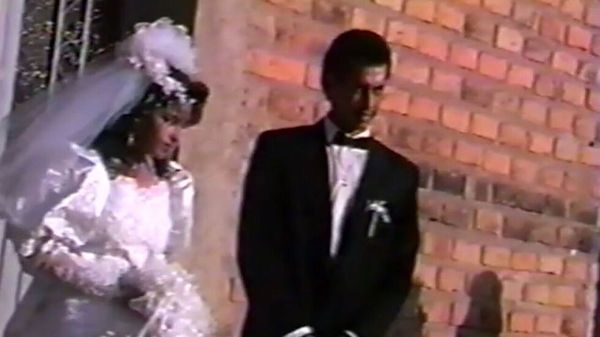
Also utilizing 1990s camcorder footage, director Eddie Sánchez’s brilliantly edited documentary Mexicanamerican rifles through the home movies of his childhood, interspersed with present-day interviews of his parents, Lalo and Beby. Originally from rural Mexico in Jalisco, Lalo and Beby crossed the border and settled in America in 1993, raising Eddie and his two brothers, who were all born in the United States.
The home videos were shot in part so that the parents could share the lives of their children with their extended family back in Mexico. The images are glitchy and low-resolution, feeling very much of their time. Occasionally, and sometimes humorously, other taped programs interrupt the footage, including melodramatic telenovelas and MTV’s 1993 The Real World: Los Angeles.
Eddie and his brother Edgar were, by all accounts, lovingly raised by their parents, who both worked as cleaners. Eddie and Edgar would later receive scholarships to Northwestern University, but both note that they also battled depression later in life while wrestling with the Catholicism and conservative values of their upbringing. There’s also a lingering sadness hovering over the footage, of something missing in their relationship to the extended family who viewed these videos but whom they rarely saw.
Lalo and Beby are somewhat reserved in the interviews, though they gradually open up, including when recounting their sweet initial meet-cute. Both have learned English primarily through television, though Beby still mostly speaks Spanish. This contrasts with Eddie and Edgar, who as children were reluctant to speak Spanish when asked by their parents.
Like another recent autobiographical work, Karla Murthy’s affecting The Gas Station Attendant, which also employs extensive camcorder footage, the documentary could have easily been more explicitly about immigration politics and policy of its era, and of today. Instead, the film is more invested in reckoning with one’s past and in relaying experiences that, while singular, are also ordinary and familiar.
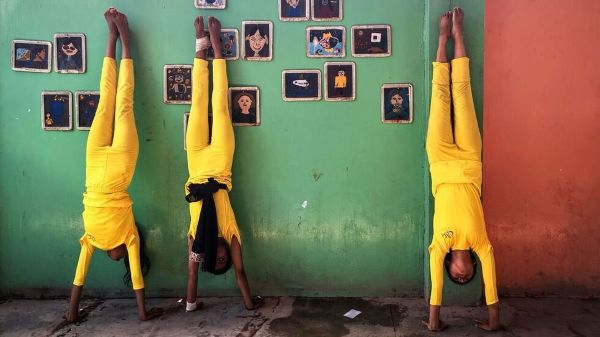
While not formally adventurous, Habiba Nosheen’s engaging documentary The Gymnasts of Fisherman Colony spotlights a unique group of individuals: a gymnastics team of young Pakistani girls in Machar Colony, a sprawling settlement of Karachi. Many who live there are referred to as being “stateless” or undocumented. Fishing, the area’s primary industry, is largely performed by men, while women and children peel shrimp.
Before the team was established in recent years, many relatives opposed seeing girls participating in gymnastics. Girls are often encouraged to study the Quran and marry by age 17. But many of the girls, seeing boys getting to do the same sport, pressed to take part and help create a team, even if some feel sometimes that they are “sinning.” The girls start training young, ranging in age from eight to 11. The team’s main coach, initially trepidatious about teaching girls, is the only one willing to do so. He is more interested in them building confidence and performing than chasing after medals.
Still, the promise of competitions and trophies can also mean money, which benefits the girls’ families, many of whom struggle to find work because they lack citizenship. As the film unfolds over several months, two girls end up married. Here, marriage for young women is favored over education, let alone sports. However, when the story narrows to focus upon the ups and downs of Sonia, the film truly takes flight with her as she competes in a competition against other girls in Pakistan. She is an inspiring figure and soon becomes a beacon for the future of gymnastics in the region.
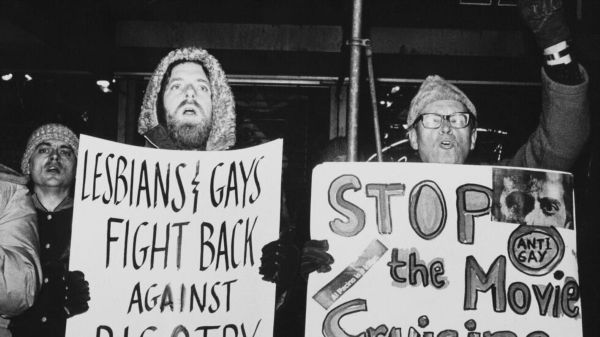
The lurid title, Mineshaft: The Cruising Murders, is slightly misleading. It sounds as though it could be a hackneyed true crime documentary, but Jeffrey Schwarz’s documentary is more invested in the controversies surrounding the making of William Friedkin’s Cruising, the notorious 1980 Al Pacino-starring film. It recounts the massive protests by queer activists during the film’s making in New York City, who were angered by its violent premise, arguing that it represented a derogatory depiction of the gay community when LGBTQ+ representation onscreen was rare or limited to stereotypical caricatures.
Schwarz also touches upon the “Bag Murders,” a spree of killings connected to New York leather bars, and on Addison Verrill, a Variety journalist murdered in his West Village apartment by a hookup, Paul Bateson, in 1977. Bateson, who coincidentally played a bit part in Friedkin’s The Exorcist, inspired Friedkin’s story, in which Pacino plays a straight cop who goes undercover in leather bars to catch a serial killer. (The film was adapted in part from a 1970 novel by Gerald Walker, but the shades of sadomasochism and leather bars were added to the screenplay.) Rather than sensationalizing these events, the documentary humanizes both Verrill and Bateson, featuring interviews with Verrill’s sister, Pamela Verrill Walker; his ex-lover Bob Geary; and Ken Oliver, a longtime friend of Bateson.
Schwarz’s film is engrossing and informative, especially for those who do not know much about Cruising or the gay rights fights of the late 1970s (clips of Anita Bryant figure in). For those already familiar with the material, it sheds little new light, except for the inclusion of Walker, who eloquently reminisces upon her brother. Still, the footage of the fevered protests against Cruising and the disruptions of its on-location shooting is fascinating. Likewise, Friedkin’s notorious film, largely reviled by audiences and critics upon release, has become an intriguing relic—illustrative of a twilight era of gay nightlife just before the AIDS crisis.
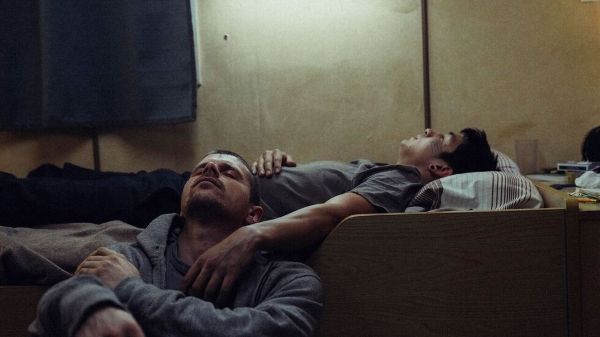
Another queer-themed film is director Rodrigue Jean’s moody Labrador—Autopsy of Silence, which fittingly opens on an icy landscape in Canada’s Nunangat region. Alupa (Christopher Angatookalook), an Inuit ship mechanic, shoots a seal beneath the ice and then skins it with a knife (a scene perhaps not for animal lovers, nor the faint of heart). His lover, Alex (Alexandre Landry), a chef on the massive cargo ship where they both work, stands nearby, watching. In this carefully calibrated tale, the strange opening scene, and a few others as well, ultimately end up becoming narrative tricks, many of which I didn’t catch until a second viewing.
Aboard the vessel, everyone hides a relationship from everyone else. Both Alupa and Alex are closeted, carrying on sexual trysts after hours. They are under the watchful eye of stern First Officer Michelle Comeau (Gabrielle Poulin B.). Michelle has a boyfriend of her own, yet she hooks up with Alex whenever she can. Though he doesn’t seem to be as emotionally interested in her, she remains an authority figure over him. When tragedy strikes, a mystery unfolds, though it is sadly foreseeable who will ultimately take the blame.
Mathieu Laverdière’s cinematography is appropriately murky and chilly, featuring beautiful shots drifting across the icy seas of Basse-Côte-Nord. The ship feels vast and steely, with eerie, greenish lights and seemingly endless corridors and railings, all of which add to the ominous atmosphere.
Everyone is stoic and internal, and there is very little conversation amid the loud metallic groans of the ship. The crew wear heavy jackets and hard hats, making it somewhat startling whenever we see them vulnerable and nude. Much of the dialogue is delivered flatly, with little overt emotion. The courtroom scenes in the latter half do not deliver much in terms of dramatic tension. Yet there’s something powerful about Alupa’s presence—particularly in Angatookalook’s performance—as he faces the ingrained injustices of the judicial system, leaving an impression that lingers.
Labrador — Autopsy of Silence won three awards out of the festival, including Best International Narrative Feature, Best Performance in an International Narrative Feature for Angatookalook, and an award for its cinematography.






Leave A Comment