Sometimes the qualitative gap between premise and setting can make all the difference in elevating a film, at least when one of the two is compelling enough to compensate for the other. But what happens when you have three half-baked premises stacked together to form something only marginally coherent and a setting that confuses claustrophobic with simply boring? Here is Hokum, a horror movie that tries to feed us more than it is able to serve.
Written and directed by Irish filmmaker Damian McCarthy (Oddity) and carrying the distribution label of Neon—a studio that has defined much of its identity as a home for original horror films when it is not hunting for potential winners at the Cannes Film Festival—Hokum shows some promise at first. It opens with an exuberant scene set in the desert, where a stranded Spanish conquistador and a boy are unable to find a way out unless they manage to retrieve a map trapped inside a sturdy bottle. Surrounded by nothing but sand, the conquistador decides that the only way to break the bottle is by using the boy’s head—an immediate indication of the kind of person he is. How did they get there? Why is he so determined to do something so cruel? This turns out to be the final stretch of a trilogy that a famous writer—likely tired of the story and characters that have brought him fame and fortune—is trying to bring to a resolution.
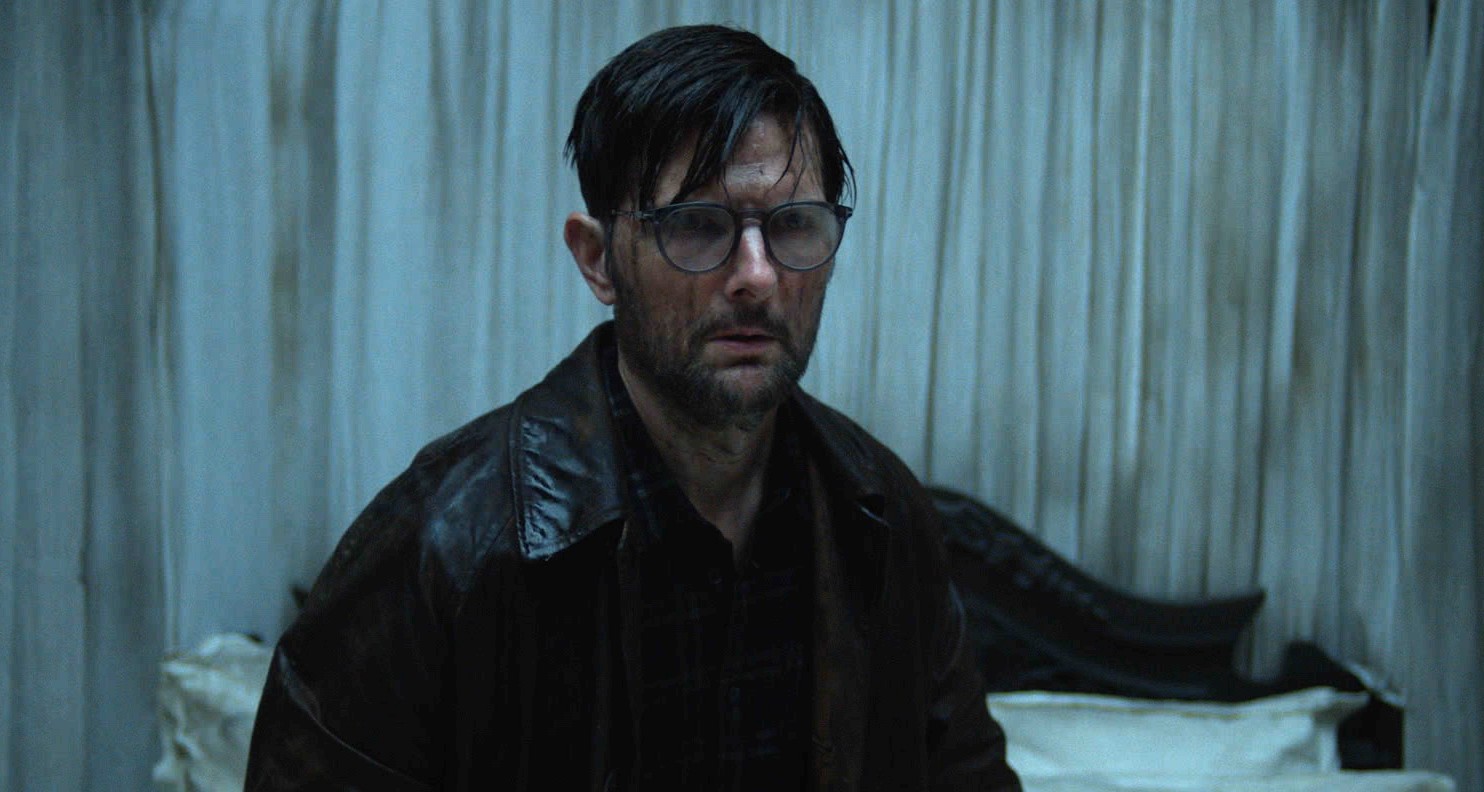
American author Ohm Bauman (Adam Scott) is going through a difficult moment, both creatively and personally. His solitary life, his constant contemplation of a photograph of his mother—who died when he was just a child—a certain degree of creative block, and the ashes of his parents that he has kept for years without knowing what to do with them all combine to lead him to a decision: He retreats to a hotel in Ireland where his parents honeymooned and were perhaps happiest before tragedy struck. His father died years later after becoming a widowed alcoholic, affected by the death of his wife—an event that has haunted the memory and dreams of his son. Despite this, a positive outcome emerged: Ohm ended up becoming a writer of bleak fiction.
At the Victorian–era hotel, Ohm hears mentions of an upcoming Halloween party and anecdotes about a suite whose access is forbidden due to the legend of a witch said to haunt the room. He also encounters curious and eccentric characters, such as the elderly Jerry (David Wilmot), who drinks milk mixed with psychedelic mushrooms and is suspected of having carried out a mercy killing on his sick wife. There is also the irritating bellboy Alby (Will O’Connell), who insists that Ohm read his manuscript, and the kind Fiona (Florence Ordesh), who is not intimidated by the writer’s surly and misanthropic demeanor. All these elements seem attractive enough for the development of a horror film set in a hotel. Of course, because it involves a writer, we immediately think the worst-case scenario would be a blatant copy of or homage to The Shining. If only.
On that first night, Fiona insists to the staff that they should check on the writer, who went to bed early after several drinks. Her instincts prove right: Ohm is hanging from a ceiling light in what could have been a successful suicide attempt. Days later, Ohm wakes up in a hospital bed. Once he has recovered, he finds that the hotel is about to close for the season. He is also informed that Fiona disappeared on the night of the Halloween party. Ohm questions the manager about the forbidden room, and the manager confirms that it was never searched by the police. At this point, you begin to notice some of the film’s narrative problems as it introduces more situations and new mysteries that simultaneously break the dramatic tension built up until then. Why mention a Halloween party if the storyline barely engages with it? Why hasn’t the mystery of the haunted room mattered so far?
The script feels composed of ideas and scenes from different movies assembled into one, without regard for the viewer’s patience and expectations, nor for basic common sense regarding what works as suspenseful horror. The movie makes the same mistake a second time, prolonging the confrontation with what it has established as its source of horror, until Ohm finally returns with the older Jerry to investigate what happened to Fiona, as both feel responsible and concerned for different reasons.
By this point, the film is already carrying the weight of Ohm’s guilt over his mother’s death, his suicide attempt, the unresolved ending of the conquistador trilogy, Fiona’s disappearance (as well as the possible complicity of certain hotel figures in it), and the question of whether the witch of the honeymoon suite is real or mythical. It is astonishing that none of this manages to produce even a moderately exciting result. Instead—for the third time—the film allows Ohm to rest without anything horrifying happening, despite him falling asleep in the very suite he has been warned about.
Meanwhile, some revelations arrive far too early (such as what happened to Fiona), and the mysteries are completely disconnected from one another. The witch—yes, she finally appears—has absolutely nothing to do with the writer’s trauma and past, nor with what happened to Fiona. If all of this exists as an excuse for the writer to finally complete his story, there does not seem to be much correlation there, either.
Hokum lacks the necessary narrative glue to justify its overload of elements. At the same time, its execution and setting leave much to be desired. The haunted room is bland despite certain gothic motifs, and the hotel never feels intimidating or overwhelming. There are a few jump scares (you can almost hear the executive who suggested their inclusion just for the trailer), but McCarthy seems undecided about whether he wanted to make a supernatural horror film, a more grounded procedural, or a metanarrative drama about artistic creation.



Leave A Comment