
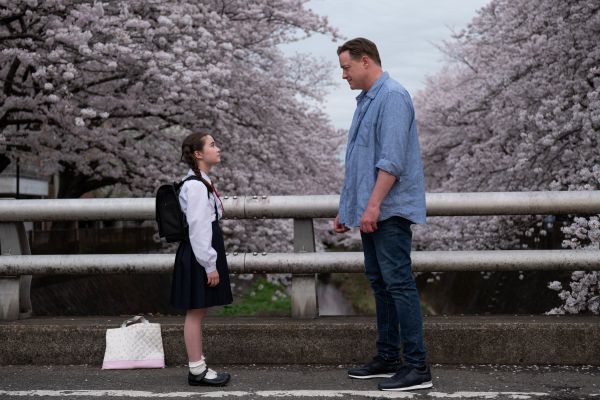
Rental Family arrives in time for the holiday season as an earnest, though innocuous, feel-good movie for the armchair traveler. Director/co-writer Hikari offers non-Japanese audiences slices of life filled with enough visual stimulation in and around Tokyo to satisfy Travel + Leisure readers. (The nighttime cityscapes of high-rise apartments filled with single, isolated residents resemble an Edward Hopper painting multiplied by the hundreds.)
Having lived and worked in the country for seven years as an actor, Phillip (Brendan Fraser, in aw-shucks mode) is awakened by a call from his agent for a last-minute job that begins immediately: to play a sad American mourner at a funeral. Breathless, he arrives late, after the ceremony has already begun. His awkwardness turns into bewilderment when he notices the corpse in the open casket crying during a eulogy. As he finds out afterward, Phillip has been hired by Rental Family, Inc. Its mission, according to its manager, is to “sell emotion.” Clients hire the three-person office to role-play in real-life complicated situations, and they have a need for a token White, middle-aged male for upcoming gigs. (It is an actual field of business.) Yorgos Lanthimos’s Alps (2011) also tackled a variation on this theme.
Phillip, haltingly, considers the steady employment. Though he once starred in a nationwide ad campaign with a jingle every Japanese person knows by heart, he lives modestly in a small studio apartment, with laundry drying on the balcony. He accepts the role of a bridegroom but tries to back out at the last minute, dashing into the men’s room to hide in a stall as the wedding is about to begin. As an actor, Phillip has always looked for significant work, something meaty, a role that has “real meaning,” in the words of his colleague-to-be Aiko (a very good Mari Yamamoto). Her calling card for the company is playing a substitute mistress—a punching bag for angry, betrayed wives. Too late to back out, Phillip gives in. After successfully taking part in the religious wedding ceremony, he becomes the small outfit’s go-to White guy. For another assignment, he plays the biological father of a biracial Japanese girl who was raised by a single mother. All three are to be interviewed by the admissions office of an elite school, presenting the picture of a happy home.
When the assignments—and the actions of others—become too puzzling for this fish out of water, his boss nonchalantly advises Phillip that as a foreigner he can’t fully understand the social rules of the Japanese. Yet, a viewer might see a red flag waving when Phillip’s job involves the likelihood of emotionally manipulating nine-year-old Mia (Shannon Mahina Gorman), who has never had a father figure in her life. Though the screenplay covers many social mores, or at least touches on them, no one raises an eyebrow or has anything to say when Phillip poses as the White spouse of a Japanese woman in two jobs. The issue of race is off the table.
In a nod to 1990s filmmaking—especially its romcoms—a montage set to pop music follows Mia and Phillip (known to the girl as Kevin) as they frolic through Japan. He even gives her his phone number to call anytime. And talk about atmosphere: One of their jaunts includes joining the parade at the Monster Cat Festival. (Ailurophobes, you’ve been warned.) Mia becomes attached and makes Phillip/Kevin swear he will never abandon her. However, a paternal bond wasn’t part of the assignment. Mia’s mother just wanted her daughter to get into a fancy school so she’d be prepared for a top university. (Does this sound familiar to anyone?) Wise beyond her years, Mia doesn’t suffer fools gladly. However, as directed, the spunky know-it-all is one pout away from becoming cloying.
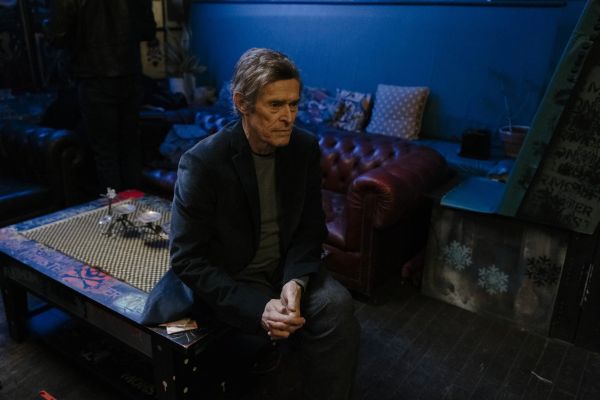
Speaking of the 1990s, Rental Family feels aligned with the mid-budget, ultimately wholesome, high-concept movies that studios like Disney’s Touchstone Pictures used to crank out. The sordidness of how Mia has been used is quickly resolved, not to mention the circumstances surrounding Phillip’s dealings with an older, noted actor who has dementia. Viewers won’t see anything messy on the street, nor are they going to find it in any of Phillip’s assignations—at least not for very long. Instead, you get sap with the sake. What starts out with a precocious premise ends up with a bland reconciliation. Like many of the participants in the various scenarios, viewers have been played.









Leave A Comment