
Tron: Ares boasts stellar neon visuals and an enthralling techno score, but its compelling aesthetic is held back by a predictable script that fails to match the strength of its look. The movie, for better or worse, follows in the footsteps of its predecessors.
This continues the paradox of the “Tron” franchise: it’s a groundbreaking series with a cult following that has never quite become a major Disney IP. The original 1982 Tron was a pioneer of heavy CGI, and its 2010 sequel, Tron: Legacy, further refined the look and feel of the digital Grid Kevin Flynn (Jeff Bridges) visited decades ago. While both films left a graphical mark on audiences, the stories guiding these journeys were formulaic. Ares offers fleeting signs of that signature Tron futurism as it updates the series for a world where the digital frontier is more real than ever.
Since Flynn’s disappearance inside the Grid in Tron: Legacy, a corporate turf war has raged between Encom and Dillinger Systems—belonging to the family of original villain Ed Dillinger—for control over the tech sector. Now led by Dillinger’s grandson Julian (Evan Peters) and new Encom CEO Eve Kim (Greta Lee), both companies race to create resources out of thin air via hyper-advanced 3D printing. This technology can do anything from growing crops in hostile climates to generating Grid-based weapons. However, the digitally-rendered constructs only last 29 minutes before disintegrating, threatening Dillinger Systems’ profits.
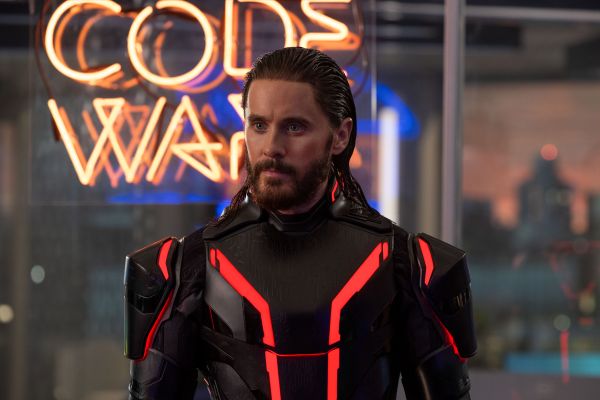
The solution arises when Eve discovers Flynn’s long-lost Permanence Code on an old floppy disk. This strengthens the constructs’ durability and opens the door for more advanced AI creations. Eve partially seeks this goal out of grief for her late sister, Tess, a former Encom leader. Julian, however, wants the code to stabilize his own creations. This corporate battle escalates into cyberwarfare when Julian deploys Ares (Jared Leto), a digital soldier. The AI warrior can exist in the real world and be rebuilt if destroyed. As Ares hacks into Encom’s files, he starts to question his programming. Like the Frankenstein passages he begins quoting, the creation turns on its master, leading to chaos in both the Grid and reality.
A “Tron” movie is supposed to present cutting-edge set pieces while also exploring deeper themes about humanity and technology. Ares delivers on the former but only skims the surface of its ideas, a missed opportunity at a time when AI fears are prevalent. Despite the controversy surrounding his casting, Leto gives an entertaining performance, though Ares feels limited to two settings: stoic digital soldier and 1980s-loving road-trip buddy. Lee and Peters are credible in their roles as the mournful protagonist and gleefully arrogant antagonist, but supporting actors like Anderson and Hasan Minhaj are underutilized. Jodie Turner-Smith fares better as Ares’s ruthless lieutenant, Athena, while Cameron Monaghan’s role is nearly nonexistent, raising questions about what was left on the cutting-room floor.
The standouts of Ares remain its neon-lit fights, digital worlds, and the moody score by Nine Inch Nails. The visuals aim for a hodgepodge of old and new, keeping Legacy’s LED armor and weaponry but limiting its scope to more controlled environments reminiscent of the original. The biggest surprises are reserved for the final act, where Ares ventures into a throwback Grid to meet a 1982-era Flynn (Jeff Bridges). While this cameo may delight longtime fans, it could equally puzzle younger viewers introduced to the universe through Legacy and its underrated tie-in cartoon, Tron: Uprising.
This nostalgic trip, however, exposes the biggest issue with Ares. However cool Disney’s latest rendition of the Tron universe looks, this traditionally forward-thinking IP relies too heavily on the past to sell its story. From zapping characters into the Grid to rehashing the same corporate rivalries decades later, it’s old software on new hardware. The movie is occasionally fun for its video game elements, but it still needs upgrades to feel truly innovative and reliable.









Leave A Comment