
Disclosure Day has long been shrouded in mystery. The title for Steven Spielberg’s new sci-fi film wasn’t even revealed until its trailer dropped last December, with marketing keeping the exact nature of its storyline intentionally vague. This is impressive for a blockbuster, and completely expected for one of the most recognizable directors in all of cinema.
Spielberg, of course, began his career directing genre-defining classics about humanity discovering alien life, such as Close Encounters of the Third Kind and E.T. the Extra-Terrestrial, and I’d argue Disclosure Day rounds out those films as an unofficial trilogy. It might, though, leave a few unanswered questions on the table in its frantic race against time to expose the truth. Nevertheless, Disclosure Day succeeds as a sci-fi thriller about uniting a world on the edge through the most interstellar of concepts, and it serves as another reminder that no one can make emotionally stimulating popcorn flicks like Steven Spielberg.
Questions about what’s going on are raised almost immediately, with cybersecurity specialist Daniel Kellner (Josh O’Connor) receiving a mysterious, hexagonal, prism-shaped object known simply as “the device.” Obtaining it, however, means stealing from his former employer Wardex, a private corporation with high-level military clearance, which makes him Public Enemy #1 for the agency’s leader, Noah Scanlon (Colin Firth). As Daniel goes on the run with his girlfriend, Jane (Eve Hewson), his main point of contact is his handler, Hugo (Colman Domingo), though it’s unclear to Jane—and by extension, the audience—what Daniel is hiding or what mission is so vital to Hugo’s organization.
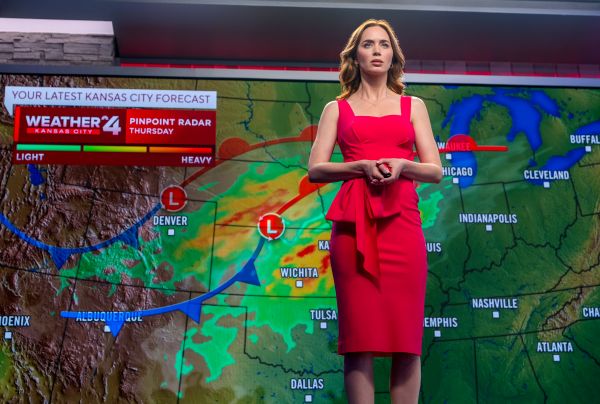
The missing link in this plan is Margaret Fairchild (Emily Blunt), a weather presenter for a local news station in Kansas City, Missouri. Uncertain if she wants to remain there or move her career elsewhere, something changes in Margaret after she witnesses an uncanny-looking cardinal fly into the loft she shares with her partner, Jackson (Wyatt Russell). Suddenly, she can read people’s memories and unconsciously speak multiple languages, including a series of indecipherable noises on-air that everyone attributes to a stroke or seizure. In reality, she’s the mediator needed to help Daniel and Hugo reveal files documenting 79 years of Wardex and the U.S. government covering up the existence of UFO sightings.
It’s a lot of moving threads to take in, and Disclosure Day cleverly juxtaposes this chase against a more subtle ticking clock of a looming World War III in the background. Discovering that humanity isn’t alone in the universe, the movie suggests, has the chance to unite us against our worst instincts, despite the possibility of upending all we know about ourselves. Questions of truth, religious faith, and morality are raised throughout, but with an empathetic lens unique to Spielberg’s filmography that makes it feel weightier than the usual “alien cover-up” trope. That our protagonists feel remarkably ordinary, despite the knowledge they’ve learned or gained through this exposure, only adds to the drama.
While Spielberg never loses control of the wheel, he builds up so many questions that you don’t realize only a handful are being prioritized over others, likely a result of the film’s constant forward momentum. The ending, in particular, certainly delivers on its grand, alien-centric mission, but you can’t help but feel it leaves the cast little room to react, making them feel more like witnesses to a life-changing event in history.
The film’s technical side is nothing short of remarkable, of course, with Spielberg reuniting his entire all-star team to ensure this vision is fully realized. Familiar faces include David Koepp as screenwriter, Janusz Kamiński as cinematographer, and, of course, John Williams as composer. Each uses their signature talent to make the visuals, score, and dialogue flow in tandem with one another. Extra points go to the humor in between serious moments, with the biggest laugh coming when Margaret and Jackson struggle to drive a car over her phone to avoid being tracked. Yet the serious moments and set pieces contain naturalistic weight as well, from a harrowing psychic interrogation to a car collision with a moving train that pays direct homage to 1971’s Duel.
If Spielberg’s last movie, The Fabelmans, represented the director becoming comfortable opening up about himself, then Disclosure Day applies that wisdom to revisiting his past movies. The old themes are still there—right down to a childhood perception of aliens as fairy tale–coded—but there’s a maturity to these mysteries and what they say about humanity in a more cynical era. Everyone will have thoughts on where this ranks within the Spielberg pantheon, but Disclosure Day’s status as a fast-paced, fun summer blockbuster can’t be ignored. The truth, you might say, is out there on the big screen.






Leave A Comment