
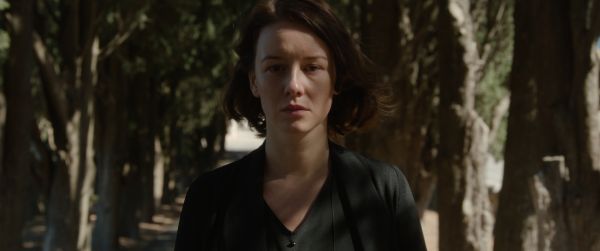
Michael Winterbottom’s latest film is a deftly handled biopic of Shoshana Borochov (Irina Starshenbaum), daughter of Ber Borochov, a founding figure in Labor Zionism. This strand of Zionism advocated for the establishment of a Jewish homeland through immigration and labor—particularly building settlements—rather than relying on appeals to powerful nations for political independence.
Beginning in 1938, Shoshana follows its titular heroine through a turbulent decade in Tel Aviv, then part of British-administered Mandatory Palestine. (Her father had died more than two decades earlier.) The city is a political tinderbox. Under a League of Nations mandate, the British are tasked with maintaining order amid rising tensions between the Jewish and Arab populations. In this volatile atmosphere, Shoshana begins a passionate affair with Tom Wilkin (Douglas Booth), a British officer in the Palestine Police Force.
Their relationship is intense and sensual, even though they are on opposing sides to an extent. While Shoshana supports the creation of a Jewish homeland through political means, she is incensed by the increasingly brutal tactics of the British police toward more radical Zionist factions. To the British authorities, though, such tactics are a necessary response to an ungovernable situation marked by bombings, assassinations, and insurgent activity.
Wilkin’s superior is Geoffrey Morton (Harry Melling), a hardliner whose methods are questionable at best and unlawful at worst. Morton distrusts Wilkin’s leniency—especially in light of his relationship with Shoshana, whose brother is drawn to the Irgun, a militant Zionist group. Led by Avraham Stern (Aury Alby), the Irgun seeks to force the British out of Palestine by any means necessary, including terrorism. Their bombings and attacks often result in the deaths of civilians.
While Shoshana effectively dramatizes the fraught dynamics between the British and Jewish populations, it sidelines the Arab perspective, relegating them largely to the background. This omission feels pointed, especially considering Winterbottom’s prior work grappling with complex geopolitical subjects, including The Road to Guantanamo, Welcome to Sarajevo, and A Mighty Heart, about the murder of journalist Daniel Pearl. Instead, he homes in on the central disconnect between the governing British and Jews striving to establish their own nation—a focus that is dramatically compelling but leaves the sense that the story’s full historical scope deserves more than a two-hour treatment. A multipart series might have allowed for greater nuance and depth.
Even so, what the film depicts is often startling and substantive. Winterbottom interweaves archival footage—including Zionist militant operations, the onset of World War II, and the eventual 1947 UN vote to create the state of Israel—giving vital context to the many entangled ideologies, relationships, and political factions.
The ensemble cast is uniformly strong, led by Starshenbaum’s intelligent, quietly forceful performance as Shoshana. Winterbottom wisely gives her the final word. “I had always believed in the Israel my father dreamed of, where Arabs and Jews could live side by side,” she says. That dream feels distant 80 years later—especially as the film concludes with Shoshana joining a militant group targeting Arabs after the British withdrawal—yet her words still carry a sense of yearning. There remains, however faint, a glimmer of hope.



Leave A Comment