
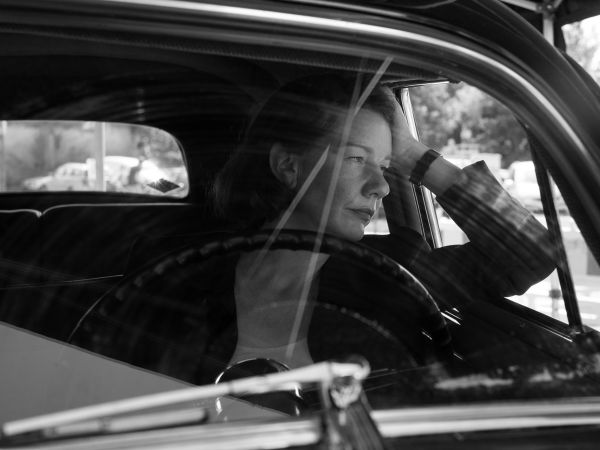
Few filmmakers approach history with the discipline and restraint expected of a historian. When given the opportunity to work with a certain budget to re-create and reconstruct the past, directors tend to erect epic and passionate stories of considerable length. Director Paweł Pawlikowski, a singular case in recent cinema, is interested in approaching history through fiction with the utmost rigor, while at the same time remaining committed to telling stories within a reduced, patience-proof runtime.
After Ida (2013) and Cold War (2018), Fatherland, the Polish director’s new film, stands as the third entry in a symbolic European trilogy that explores specific circumstances in lives affected by the tumultuous years of World War II, and the traces and scars left in the aftermath. The levels of emotional restraint vary in each one (Cold War, for example, is an epic love story of profound passions), but all of them share the solemn monochromatic cinematography by Łukasz Żal and a runtime of under 90 minutes (including the end credits).
Of course, a runtime never really defines the quality of a film, but if there is one minor flaw in Pawlikowski’s cinema that is debatable, it is, curiously, the feeling of falling short. Fatherland, without being an exception within this trilogy, also incites this desire to want a little more of what has been so enriching and unsettling. In this case, the film focuses on a specific episode in the life of German writer Thomas Mann: his visit to his homeland in 1949. From there, the biography of a distinguished author gradually dissolves into a portrait of a nation divided (in so many senses), barely beginning to rebuild itself from both its material and moral ruins, while discreetly foreshadowing the problems that will define its future.
Included as part of the Main Slate at the 64th New York Film Festival, Fatherland will surely have a fruitful run among specialized audiences (film lovers, history buffs, literary scholars). This may be the Pawlikowski film that best achieves the ideal balance between individual and collective history, because everything in it is confined to what has been previously documented. However, Mann (Hanns Zischler) does not emerge as the lead protagonist here, with his daughter, Erika Mann (Sandra Hüller), seemingly inspiring greater curiosity and interest in Pawlikowski and Henk Handloegten’s screenplay.
A fascinating figure in her own right, Erika (an actress and writer) is portrayed during this particular period in which she acts as assistant, interpreter, and bridge between the writer and the rest of the world. A man already in the third act of his life and career, Mann has written some of the fundamental books of his time and generation (Death in Venice, The Magic Mountain, Joseph and His Brothers). All things considered, he takes advantage of the excuse of receiving the Goethe Prize in West Germany to reconnect with the home that will never again be as he left it. This will be followed by replicated honors across the border in the East (Weimar), a region that is already beginning to inspire concern and caution in the democratic world.
Erika cannot help but see the contradictions, ills, and guilt of a virulent nation in which her father is “background music” (as she calls him), or a charade meant to legitimize a certain normality and cultural reintegration. At the first award ceremony, she encounters her ex-husband, actor Gustaf Gründgens (Joachim Meyerhoff), a careerist who remained on good terms with the Nazis and now expects his past to be forgotten. A well-deserved slap provides one of the film’s most enjoyable moments (and one of Hüller’s best in her performance).
A third fundamental figure appears only in the opening scene (a telephone conversation with Erika), and whose subsequent suicide permeates the travels for its two protagonists: Klaus Mann (August Diehl), brother and son, who was also invited to take part in the visit. Thus, mourning over a recent loss and the bitter nostalgia for a vanished country transform the journey for the Manns into a progressive revelation of uncharted times.
The most complex stretch is the visit to the region occupied by the communists, where Mann is welcomed by singing children, taken on a tour of the house where Goethe died, and photographed more or less with tacit consent. During his visits to the two Germanies, Mann’s presence acts as an instrument of propaganda. However, in Weimar his speech (almost identical to the one given in democratic Germany) and the applause he receives carry a more sinister undertone, especially after an encounter in which a stranger slips into Mann’s hotel room to ask him to advocate for political prisoners held in a concentration camp.
Fatherland spares us moral judgments and didacticism, allowing us to weigh the historical circumstances of this visit and what we know about it. With impeccable narrative economy, this isolated episode provides an illuminating snapshot of those uneventful moments in history that are usually neglected or passed over in historical fiction: the days after or the following year, when a fragile and questionable peace can stretch out in relief even as renewed struggles begin to take their first steps.



Leave A Comment