
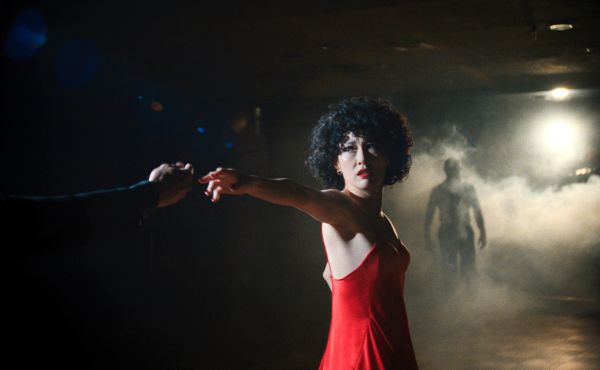
Having tackled drug smuggling in Colombia (Manos Sucias) and the sex trafficking of Native American women (Catch the Fair One), director and co-writer (with Nicholas Huynh) Josef Kubota Wladyka pivots to ballroom dancing and surreal fantasy in his charming third release, which is dedicated to his ballroom-dancing mother. Winner of the U.S. Dramatic Directing Award at the 2026 Sundance Film Festival, his multilingual, multicultural dramedy features a winning and touching comic performance by Academy Award nominee Rinko Kikuchi (Babel).
As the film opens, 45-year-old Haru (Kikuchi), sporting a tiny gold nose ring and a retro-Afro perm, is living happily with her Mexican husband, Luis (Alejandro Edda), in a cozy Tokyo house filled with vinyl records. (Kudos to production designer Masami Tanaka for creating such an appealing backdrop.) Luis lovingly prepares oyakodon with jalapeños, and the two watch their ballroom dancing rehearsals on her iPad as they eat, trading critiques in a mix of Japanese, Spanish, and English.
When the couple hit the dance floor at a local competition, Haru imagines them dancing in the air above the crowd—until a fatal heart attack fells Luis and sends Haru crashing back to earth and reality. Stunned with grief, she can barely function. After reluctantly allowing Luis’s father (a moving Damián Alcázar) to take his son’s body back to Mexico for burial instead of committing him to the Japanese cremation ritual of kotsuage, Haru turns over custody of Luis’s dog to her supportive sister, Yuki (Yoh Yoshida), and sinks into a deep depression. She soon begins to see a big, mascot-like crow around the house. Clearly, this spirit represents both her late husband and her own grief.
Nine months later, after Haru skips the 46th birthday party planned for her, a worried Yuki and Hiromi (YOU), their free-spirited cousin visiting from the States, intervene. “You need to dance. Shake your booty,” says Hiromi as she and Yuki urge a hesitant Haru back into the dance studio. There she meets sexy new instructor Fedir (a seductive Alberto Guerra), and Haru is dazzled. “Are you ready to make love…to the rumba?” he asks during a private lesson. Desire reawakened, Haru begins to pursue Fedir, inviting him to dinner, sharing her passion for an entertaining Japanese stage adaptation of Dirty Dancing, yet never revealing her widowhood. The arrival of Fedir’s wife, Mila (Keren Louis), also a champion ballroom dancer, throws Haru off-kilter, and her unnerving behavior comes to a humiliating climax at the dance studio’s Day of the Dead party.
As Wladyka’s effervescent yet unsentimental film reveals, people become unmoored by grief. Finding their way back to life is not straightforward or easy: “It’s okay to be messy,” Yuki comforts Haru. “That’s life.” Accompanying Haru on her journey is her vivid imagination, lighted by Daniel Satinoff’s sparkly cinematography, choreographed to Nathan Halpern’s fabulous soundtrack of Latin and Japanese classics, and costumed by the whimsical 1970s-flavored designs of Japanese designer Baby Mix. Fans of Strictly Ballroom and Shall We Dance? (both the Japanese original and the American adaptation) will find much to enjoy here.




Leave A Comment