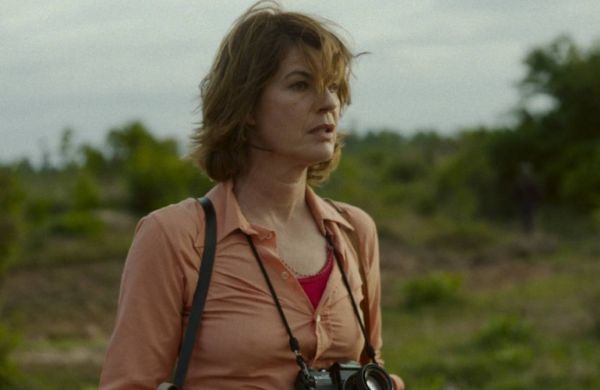
The year is 1978. The place is Cambodia, then known as Democratic Kampuchea, taken over by the Khmer Rouge in 1975 and ruled by communist dictator Pol Pot. Two journalists and one academic from France have received, and accepted, an invitation to interview the notorious dictator. Lise Delbo (Irène Jacob) is left-leaning, level-headed, and dedicated to exposing the truth strategically, without losing her cool. Photographer Paul Thomas (Cyril Gueï) is more impulsive, headstrong, and defiant. The third, Alain Cariou (Grégoire Colin), is sympathetic to the new regime, having been friends with Pol Pot when the latter studied in France. He is, it seems, a card-carrying Maoist. He regards everything around him with excitement and optimism and keeps whatever reservations he might have about the regime at arm’s length.
The Khmer Rouge present a seamless front to the three foreigners, two of whom, as noted before, are privately skeptical. They are housed in a wooden complex surrounded by tall grass and are informed, now and then, when Brother Number One (Pol Pot) will be ready to see them. They do their best to interview those who agree to it, to take pictures, and to report dutifully without rocking the boat—but the atmosphere is one of subdued tension. It is only a matter of time before that tension breaks, cracking the façade of harmony presented by the regime and the impartiality maintained by the journalists.
Meeting with Pol Pot is definitely a film with strengths. Beautifully acted, it maintains an atmosphere of suppressed horror throughout, thanks to strong craftsmanship. The soundscape of forest noises, which accompanies many of the interviews Lise tries to conduct, adds an unsettling banality—a sense that horrors can exist in an everyday setting. The recurring motif of the tarmac where the foreigners’ plane landed, across which the journalists repeatedly walk alongside soldiers and workers, becomes a portrait of the image the government tries and fails to maintain, as Cambodians are always en route to and from places the journalists are not permitted to see. There is also an intriguing experimental quality to the storytelling—sometimes incorporating black-and-white archival footage, sometimes using clay figurines (a technique familiar from director Rithy Panh’s The Missing Picture)—all of which suggests the impossibility of truly comprehending or representing atrocity.
The problem, and it’s a big one, is that the film is woefully predictable in absolutely everything it has to say. The atrocities suppressed by Pol Pot’s regime are revealed slowly. The heroism of journalists who strive to speak truth to power is upheld. The blindness of the Maoist professor, eager to sing Pol Pot’s praises, is condemned. Pol Pot’s regime itself is condemned. Anything not morally obvious or already well known is touched on lightly, if at all. Add to this that when Pol Pot finally appears, he is held in shadow and left unseen. This choice feels fundamentally at odds with the film’s greatest strength: depicting an everyday reality intertwined with a hyperbolically horrible one.
Pol Pot’s reign of terror and the Khmer Rouge’s campaign of slaughter are among the greatest atrocities the world has seen. As such, they always demand our attention. One does not want to watch a film about them and think, Why are we here? Nevertheless, that is the unfortunate result Meeting with Pol Pot achieves.

Leave A Comment