
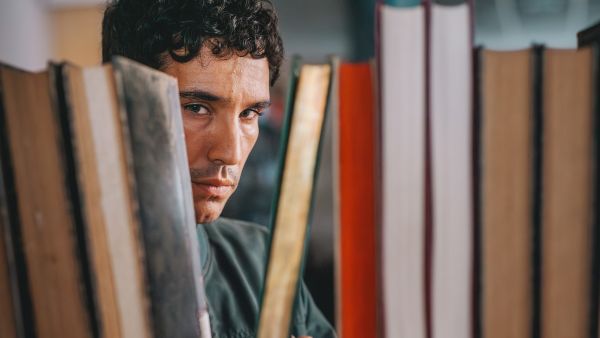
Ghost Trail is a film full of horror that is rarely seen, but deeply felt. It opens with the sound of troubled breathing in the dark, slightly louder than the rumble of an engine. After a moment, light leaks in, and in fits and starts, we see prisoners who are being taken we don’t know where. Some are crying. The door of the truck opens, blinding light comes in, and soldiers force the captives into the middle of the desert. One of them, Hamid (Adam Bessa), turns back to give the AK-47 bearing guard a forbidding look, and is told to get moving. This is as close to depicting the traumatic events—the torture in a Syrian prison camp under Assad—as the film ever gets. Yet these offscreen events will dictate much of what follows.
Two years later in 2016, Hamid works as a day laborer/construction worker in Strasbourg. Mysteriously, he travels back and forth between France and Germany, in and out of camps for refugees, in and out of a university in France, on and off of video calls with his mother, who lives in a refugee camp in Beirut. Sometimes, he meets a White woman (Julia Franz Richter) on a park bench, where he picks up a package from her and yet does not make eye contact. Sometimes, he pretends he’s playing video games on a public computer while he participates in a group chat with a select and clandestine group. Other times, he talks on the phone with individual members of this group, using code-names like “godmother.” Always, he carries a photo of someone he needs to identify, the person he believes is responsible for his torture: Hamid is part of a group of other refugees dedicated to hunting him, and others, down.
All of this makes Ghost Trail sound like a thriller, and in a way it is. An atmosphere of distrust and paranoia hovers above the action, as those Hamid approaches with the picture often treat him with suspicion no matter what he says—the understanding is that Assad’s men are everywhere, and those who have run from Syria don’t take too kindly to those who are digging up the past. And there are quite a few genuinely chilling sequences with a likely villain (the excellent Tawfeek Barhom) that only grow more menacing as we observe Hamid’s reluctant ability to carry on a normal conversation with him. Yet much of the focus here is on observing Hamid isolated and trauma-ridden against an urban backdrop and alone in his room, and in conversations between those who have experienced incredible loss. In many ways, the film feels like an extended period of waiting, rather than a propulsive journey forward. As such, it succeeds in examining the toll of seeking revenge on those engaged in it.
I previously mentioned that this is not a film where horror is not much seen, and, indeed, restraint is one of its primary strengths. Hamid’s back is covered in scars, but we almost never see them, and when we do, it is not full-on. There are no flashbacks of his time in captivity, but we observe his trembling body and his troubled face. Though we see blood once, the most vivid images are often those of the sleek city surfaces and the pedestrian interiors which Hamid inhabits. Restraint here is powerful and multifaceted and dramatically effective, signaling terrors rather than drowning us in them. It illustrates how difficult it is for those with experiences like Hamid’s to speak about them, and powerfully portrays the disconnect between the seemingly stable Western world and what is happening in so many other places.
How exactly is Hamid supposed to go on with his life after what he has been through, and what he has been forced to give up? Director Jonathan Millet’s film provides no answers, but forces us to confront the questions.



Leave A Comment