
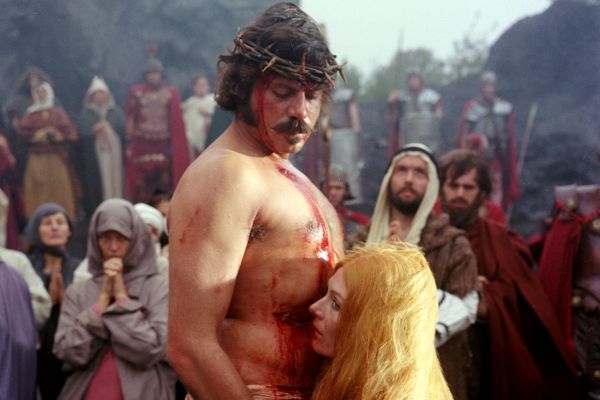
Three years after the Motion Picture Association of America effectively killed the outdated production code and implemented a new rating system, British director Ken Russell took full advantage of the new freedoms that studio films could offer with The Devils, released in 1971. He adapted John Whiting’s play The Devils, which, in turn, was based on Aldous Huxley’s 1952 non-fiction book The Devils of Loudun, about the historical witch hunt in 1634 in Loudun, France. Though the film initially earned an X rating (no one under 17 allowed), its distributor, Warner Bros., nevertheless demanded that roughly three minutes of footage be cut for its U.S. release. As if to make up for corporate censorship, the newly 4K-restored version has added back the excised scenes and is reportedly the director’s cut. It is also the first theatrical release of the new specialty film distributor Clockwork, formed under Warner Bros. ownership before its move into Skydance.
This tale of repression and hysteria remains singular, from its audacious and iconoclastic imagery to its cringe-inducing violence. Viewers will know from the beginning that this is not your standard period piece as King Louis XIII (Graham Armitage) appears as Venus emerging from a seashell, adorned as modestly as Botticelli’s famous rendering.
Among the film’s standouts is David Watkin’s vibrant cinematography, with impressive crane shots and manic hand-held camera work. The film appears dated only from the use of the zoom lens, which was in vogue in the early 1970s. It is as though the zoom lens is thrusting in and out as it centers on nude nuns ravishing a giant wooden crucifix. Subtlety was not what Russell was aiming for.
Before he turned to directing films himself, Derek Jarman was Russell’s production designer, turning Loudun into an austere, dystopian state. The predominant colors are black and white, not only in the habits of the nuns of an Ursuline convent, but also in the white brick and black mortar of the giant fortress walls of the city, which the king, egged on by the dogmatic Cardinal Richelieu (Christopher Logue), wants to tear down; no city should be allowed to fortify itself against the central government. The color scheme is also mirrored in the prison-like convent ruled with a mocking glee by Sister Jeanne des Anges (Vanessa Redgrave). The production design inevitably recalls the workers’ massive underground tunnels in Fritz Lang’s Metropolis, and appropriately so. Both movies are set in a totalitarian, insular hellscape. In the 1927 silent film, the industrialists tightly exert power, and in Loudun, the marriage of church and state has declared victory after crushing and massacring Protestants.
For those who have seen the film previously, what has been added will be quite noticeable. You will know it when you see it, such as the behavior of the nuns, who, deemed by exorcist Father Barre (Michael Gothard) as possessed by the devil, free themselves of their clothes and commit almost every blasphemy at hand. The missing scenes include the aforementioned so-called “Rape of Christ” and two moments where Sister Jeanne masturbates. However, even without these scenes, the film is more political than sensational.
It would be hard to imagine any Hollywood studio today considering, let alone greenlighting, a project that deals with religion, sexuality, and governmental brutality in such a direct and hard-hitting manner—not just because of the sexual content, but because of its prescient message about an encroaching militaristic monarch manipulated by the Church. Maybe, just maybe, a streaming service could handle it today, but it is doubtful that it would enlist distinguished actors as it does here: besides Redgrave; Oliver Reed, as the hunky renegade priest who stirs up feelings other than the sacred among the nuns; and Gemma Jones. Nevertheless, it is not every film that derives its power or shock value, depending on how you view it, from its cast of uninhibited, go-for-broke background actors.
After screening at this year’s fall festivals, Ken Russell’s The Devils will be released in the United States for one week only beginning on October 16. It is now rated NC-17.






Leave A Comment