
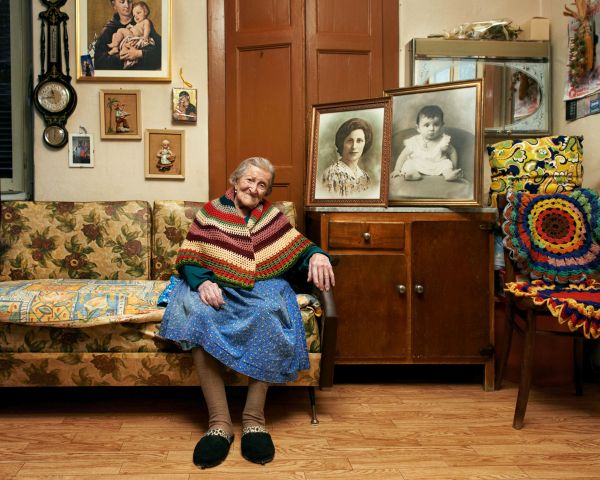
Director Sam Green’s decade-long project treks the globe (from America to France to Italy to Japan, and more) as he meets with six of the oldest living individuals, all of whom are women. Green (32 Sounds), whose frequent voice-over conveys his wonderment about life and death, was obsessed with the Guinness Book of World Records at a young age, a fascination that ultimately led in part to this documentary.
The initial oldest person featured is Susannah Mushatt Jones, affectionately known as “Miss Susie.” A Black woman born to sharecroppers in Alabama in 1899, she was living in New York City and was one of the last remaining persons known at that time to have been born in the 1800s. (Timestamping the moment, we glimpse controversial politico Eric Adams in a recreation room making remarks at a celebration for her 116th birthday.) Susie, tired and quiet, barely keeping her head up on her birthday, doesn’t offer much in terms of words of wisdom, yet her backstory is still riveting. Big questions about the meaning of life and the secret to longevity are often sprung upon these supercentenarians, which Green admits often lead nowhere.
At one point, we also peek behind the curtain of the Guinness Book of World Records headquarters. The number of record holders ebbs and flows. Sometimes the record is in limbo because of a lack of paperwork or conflicting reports on who is the oldest. There is also often a rapid turnover when one record holder dies and the next oldest person is in line to be recognized. (Green strategizes filming the “second oldest person in the world” to stay ahead.)
Though obviously well-meaning and sensitive, Green’s often intrusive narration overexplains his endeavor. Yet sometimes his voice-over works. In one of the more cinematic moments, Green tells the story of Emma Morano and the abuse she endured during a short-lived marriage when she was much younger (she would become happily single for the rest of her life) while intermixing footage from a 1930s Italian film, What Scoundrels Men Are!, which featured a ballad Emma liked to sing. At one point, Green and Emma hold hands and stare into one another’s eyes, an experience he notes is one of the most intimate he has ever had with a stranger. Perhaps the moment would have been more effective if Green had let it unfurl in silence.
The film becomes less about these record holders as it veers into the birth of Green’s son, Atlas, as well as Green’s multiple myeloma diagnosis upon turning 50, both of which happen while filming. He undergoes chemotherapy and a new drug treatment while working on the project as well. He is also haunted by the suicide of his brother, to whom he was close, when they were both in their 20s. (In one affecting aside, he returns to the parking lot where his brother was found asphyxiated in his car; the bland ordinariness of the lot is unsettling.) Green obsesses over mortality and the seeming randomness of why some people stay alive and healthy while others do not. However, his love for his son is sometimes overwhelming here, featuring long sequences of Atlas dancing, playing violin, and babbling.
Still, the result is often a meditative confrontation with death. While Green’s wide-eyed earnestness and life-affirming joy are occasionally appealing, the documentary may have been less cloying and more beguiling and mysterious with more quiet observation.





Leave A Comment