
As often happens at the annual Tribeca Festival, music documentaries formed a kind of mini-program. Among them were Rebbeca, an intimate profile of Latin music star Becky G, and the world premieres of two visual albums: Something Beautiful,from pop singer Miley Cyrus, and Turnstile: Never Enough, by the guitar-heavy Baltimore band Turnstile. Within this documentary subgenre, three films brought the British Invasion of the 1980s roaring back to life—two of them reliving the glory days of that era.
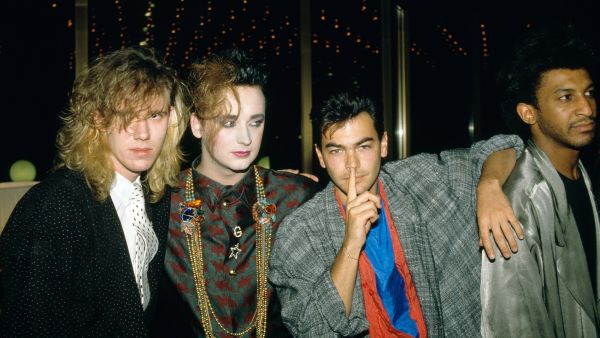
Boy George & Culture Club is the gift that fans of music publications like Melody Maker and NME would have clamored for 45 years ago, when the band was at the peak of its popularity. Though much of the behind-the-scenes drama has been covered—such as the 2010 British TV film, Worried About the Boy—director Alison Ellwood benefits from having the four bandmates speak candidly about their meteoric rise and fall. Boy George, the natural raconteur who commanded the spotlight in the ’80s, recalls those ubiquitous days when “promoting me” became the focus of his career. Decades later, drummer Jon Moss admits he was “absolutely smitten” when he first met George—they concealed their relationship as the band hit stardom. Ellwood provides more gossip by including audio of a raucous recording session, with lead guitarist Roy Hay calling George a “fat wanker.”
The film underscores how remarkable their early success was, considering two members had never been in a band and Boy George was a novice songwriter—yet their first two albums spawned hit after hit. However, the documentary occasionally feels too glib. Viewers might assume time stopped for the band members in the late ’80s when they parted ways, even though George has pursued various ventures since. Moss briefly mentions that he is currently suing his former bandmates, a bombshell that goes unexplored. Most likely, this not-quite-tell-all will be eye-opening for those who did not grow up with MTV, since many of their infectious hits are heard almost in their entirety.

Jonas Åkerlund’s Billy Idol Should Be Dead pairs perfectly with the previous film. Both dive into the late-’70s punk/club scene of economically depressed London. Famous for his ’80s dance rock pop, Idol—born William Broad—got his start in 1976 with punk band Generation X. Through that band’s success—including a career-making appearance on BBC’s Top of the Pops—he launched a solo career in New York. With his bleach-blond flat-top, pouty snare, and cherubic looks, he was made for the music video era—indeed, 1984 was a breakout year for him, paralleling Culture Club’s success.
Another shared thread between Idol and Boy George is heroin addiction. While George’s struggle is touched on in his film, Idol’s decade-long battle is extensively documented, including a near-fatal overdose. His 1990 motorcycle accident that nearly cost him a leg and his notorious $75,000 hotel-room trashing in Bangkok also make it into this profile. Now in his late 60s, Idol is refreshingly candid—echoing his younger swagger when he once declared, “I just want to get screwed to death.” Clocking in at about two hours, the film feels a bit long before it concludes at a predicably redemptive, peaceful point of his life, yet it is worth staying toward the end for a bombshell revelation.
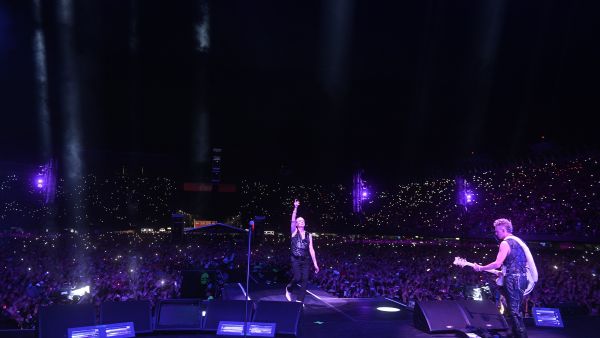
Fernando Frías’s concert documentary Depeche Mode: M was filmed before 200,000 fans in Mexico City, as the technopop group promoted their latest album, 2023’s Memento Mori (“Remember you must die”). Never fear—the concert is celebratory, not funereal. Frontman Dave Gahan prowls the stage, his movements matching the on-the-move camera work. The editing overlays human skulls and other such imagery, yet isn’t overly heavy on symbolism. (Depeche Mode were, after all, pioneers of the music-video era.) The performance bursts with energy—and for those whose connection with the band faded after their early-’90s U.S. peak, the new material proves just as catchy and enigmatic. Standouts include a thumping rendition of their hit, “Enjoy the Silence.”
Leave A Comment