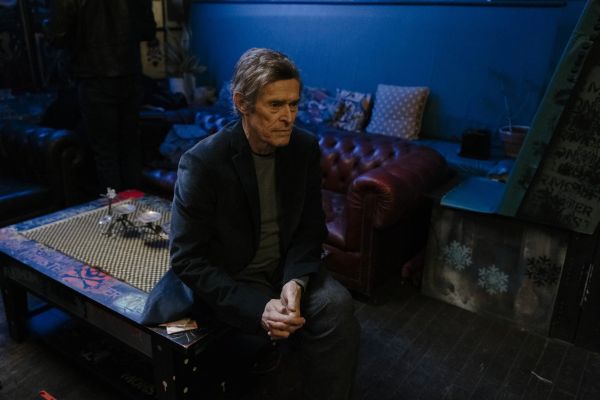
In the creative swirl of downtown Manhattan, the quiet life of a postal worker is interrupted by a contingent of young writers who uncover his decades-old book of poetry. As the group praises his “genius,” he drinks in their adulation and rethinks his life choices and current social milieu. Anchoring the tale is a very nuanced Willem Dafoe as Ed Saxberger, flawless in the melancholy trajectory of a former writer in his twilight years.
Directed with wit and sensitivity by Kent Jones (Diane, Hitchcock/Truffaut), the film’s setting is present-day New York, not the Vienna of its concise source material, a 1985 novella by Arthur Schnitzler (who also wrote “Dream Story,” the basis for Eyes Wide Shut). The unpublished book was found among the papers of the Austrian playwright and novelist in 2014. Screenwriter Samy Burch (May December) maintains much of the original material, particularly the mercurial nature of fame, which fittingly applies to modern times.
The youthful admirers regularly meet in an old-school café, drumming up excitement for “art” and “authenticity.” They call themselves the Enthusiasm Society and lionize their new elder member with compliments and cheers. Rejecting modern technology, they put down neighboring patrons who are staring into their cellphones.
Their pompous leader, Meyers (Edmund Donovan, Civil War), lives in a sleek investment property bought by his parents. His curated antique furnishings include a $1,200 first edition of William S. Burroughs’s Naked Lunch. In contrast, Saxberger’s dark apartment (in the vicinity of Film Forum, where the movie will fittingly screen) is lived-in vintage, full of old boxes of mementos—including an article on him in The Village Voice.
Basking in the group’s attention, the newly confident Saxberger finds himself drawn to Gloria, the only woman in the group. As played by Greta Lee (Past Lives), she is too youthful in the role of an aging, neurotic actress and too over-the-top as an absinthe-ordering diva to fit the tone of the film. Nevertheless, she plays the character as written by Schnitzler with extravagance.
Saxberger and Gloria circle each other, eventually kissing on a park bench while high on mushrooms, until she realizes she’s late for a cabaret gig. There, to a crowd of men, she performs a heartfelt rendition of “Surabaya Johnny” by Kurt Weill and Bertolt Brecht. Her voice is beautiful.
Tension rises as Saxberger’s rough-around-the-edges pool buddies fall short of his sophisticated new friends. His loyalty lies now with the Enthusiasm Society, who assign him a new poem for the writers’ debut public readings. He looks for inspiration while walking the streets of Greenwich Village and Soho. However, he stopped writing years ago and can’t just turn his creativity on at will.
He had originally arrived in New York during a time of artistic flourishing, when young people could live cheaply and aesthetic stimulation was abundant. Illustrating the period, the film depicts the local poetry scene of the 1970s and 1980s with archival footage of well-known bards. (It was a fertile era—the NYC Poetry Calendar would list dozens of readings in minuscule print on a tabloid sheet each month.) A new generation’s hope of re-creating this bygone era may be illusory.
Saxberger ends up reluctantly reading from his early book, Way Past Go, during the fraught event, which is held in a funky communal space packed with the performers’ friends. Despite doing well, some unflattering words uttered sotto voce in the distance begin to haunt him. The whole experience becomes a reckoning. He had always been hopeful yet skeptical of renewing his past.
A voice-over by the late poet William Carlos Williams delivers the lines: “The descent beckons/as the ascent beckoned,” an apt ode to aging and achievement. By turns wry and wistful, Late Fame poignantly underscores how creativity can mellow over time.



Leave A Comment