
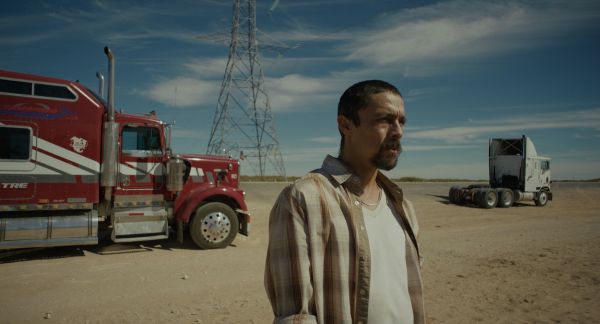
Uncompromising and unashamed of explicit nudity and gay sex, On the Road fully steps into a quasi-forbidden world—or at least it feels that way. It explores the impulses of queer desire and identity among truck drivers crossing the dangerous and often terrifying border routes from Chihuahua to Ciudad Juárez, where the unpredictable surveillance and actions of drug cartels are never far away.
This is the fourth feature by Mexican director David Pablos, who returns to raw stories where sex and violence stand on equal footing, without too many embellishments. This is especially notable after the formal elegance of his previous film, Dance of the 41, a period piece that suggested a stylistic shift toward something more in line with a studio production, even if it retold a disturbing episode of hate crimes against gay men in Mexican history.
Both films, however, are linked by an interest in understanding the desires of gay men (or men who lead lives of self-convinced heterosexuality) when they transgress conventions within particular spaces. Winner of the Orizzonti Award for Best Film at the Venice Film Festival last year, and recipient of the Queer Lion at the same edition, On the Road offers a practically unique portrait of the Mexican borderlands, where murderous drug traffickers, sex workers surviving as best they can, and rough-hewn truck drivers cross paths daily and nightly, with all the tensions that entail. Working from his own screenplay, Pablos constructs a credible world with plenty of realism, while leaving room for dreamlike moments that feel closer to an expressionist nightmare than to social portraiture. This combination elevates a character study of opposites who end up becoming, in part, accomplices, in part lovers, but above all, unlikely friends brought together by circumstance.
Veneno (Victor Prieto Simental) and Muñeco (Osvaldo Sánchez) are, respectively, a young gay hustler and thief with plenty of secrets, and a reserved truck driver who embodies the strong, silent type familiar from American Westerns. Their nicknames mean “poison” and “doll,” respectively, and at first hearing, you could easily mistake one for the other. In a sense, both men are performers of their identities, sexualities, and jobs—layers that can eventually be stripped away under the right pressure. Specifically, Veneno has escaped a fatal destiny as the former lover of a cartel boss who controls the northern routes.
Here is another tangentially transgressive portrayal of masculinity: El Eulas (Mariano López Sosa) becomes a specter of violence that could strike at any moment, but he is also another man performing a role, one who secretly enjoys keeping a house full of young men who must remain willingly available for sex whenever he wants. You might wonder whether he ever shared a few beers with Emilia Pérez before her transition, and it is hard not to recall that film, considering how rare portrayals of queer narcos remain (not that we need more of those, of course).
Flashbacks involving Veneno’s past are the moments when Pablos allows himself to transform the film’s otherwise predominantly arid, desert highway into an alluring and mysterious underworld of neon lights and bordellos, offering a glimpse of what the foundations of a Norteño neo-noir might look like. Muñeco doesn’t know Veneno’s entire backstory at first, but he agrees to give him a ride once he discovers Veneno has drugs to sell and the possibility of shared money is involved. He is aware of the consequences, yet somehow, he also feels an almost paternal compassion for this lost 20-year-old.
As they grow closer, Veneno and Muñeco discuss their sexuality openly. The truck driver directly asks the young man if he is gay, then insists that he is completely heterosexual but has nothing against those appetites, leaving at least some room for curiosity. Muñeco claims truck drivers are the best lovers because driving a big truck teaches them the rhythms and pacing needed to please someone else’s body. Of course, men like him, who spend weeks alone on the road without many opportunities to release their libido, might allow themselves the occasional detour, provided they believe the core of their masculinity remains unaffected. So you can guess that a moment will eventually arrive when their proximity allows for unrestrained intimacy between the two men. Pablos and his actors do not shy away from showing erections and sexual encounters that look almost unsimulated. There is also an intoxicating chemistry between the actors, who manage to turn the contrast between Prieto, a debutant non-professional, and Sánchez, a veteran, into an advantage.
Given the circumstances, the story does not unfold as a delicate gay romance, but rather as a portrait of survivors in which betrayals can happen at any moment. Small moments of bliss—the conversations and lunches the two share—cannot erase the hell surrounding them, a doomed world where genuine affection struggles to prosper beyond selfishness. On the Road is a haunting snapshot of eroticism enveloped in tragedy, yet it still allows for a measure of hope amid the inevitable outcomes, thanks to those moments when forsaken and desperate souls find a rare human connection that shows them there might be another road toward a different, gentler world out there.






Leave A Comment