
Looking back through time, you will find martyrs whose only crime was a love that must not be named. Looking ahead into the future, you will encounter the unknown: Will untested forms of hatred bring back fear and imposed shame? And in the present, if you have the privilege of being gay in a safe environment, after so many years of struggle and effort by those who came before you, you may ponder more than once whether your sexuality will inevitably push you toward a form of activism, even when no such obligation should necessarily exist. From this precise sense of responsibility—the inability to grant oneself either forgetfulness or ignorance—the fabric of La Bola Negra is woven, a colossal saga of gay male desire.
The complicated history of gay representation in cinema has finally produced something that any gay man might dare to call, with bittersweet pride, our Titanic. Directed by Javier Calvo and Javier Ambrossi, often known as Los Javis, an openly gay Spanish creative duo (previously associated through a years-long romantic relationship that ended during the film’s production), this film has managed to create the kind of sumptuous, exuberant spectacle by and for the gays that Hollywood has not yet dared to produce on a budget of 15 million euros (an amount already on the verge of being doubled by its Spanish box-office earnings). One that, in turn, could not exist without the codes and grammar that Hollywood movies have transformed into an export product and an inescapable influence. In other words, a landmark work with mass appeal.
Acquired by Netflix for U.S. distribution following its success at the Cannes Film Festival, where the duo won the Best Director award, La Bola Negra takes its name from an unfinished play by Federico García Lorca—or, more accurately, one barely begun, since fewer than four pages survive. The Spanish poet and playwright was executed in 1936 by the Nationalist faction, accused, among other charges, of “homosexual practices and aberration.” Los Javis take seriously the challenge of reconstructing Lorca’s play from the scant material available (while also honoring his martyrdom), combining it with a direct adaptation of Alberto Conejero’s La piedra oscura (credited as co-screenwriter alongside the two directors), a 2015 play recounting the final days of Rafael Rodríguez Rapún: Lorca’s former lover, a celebrated footballer, and a Republican prisoner of war. Alongside these adaptations, a third story set in our own time serves as the connecting thread, weaving together a palimpsest of narratives from different eras to portray a nation that still bears the scars of its Civil War. “There are so many love stories buried in the fields, and we have to scratch at the earth to bring them to the surface,” a character says near the end, when it becomes clear that the stories so often silenced or distorted are about those whose desires ostracized them as different.
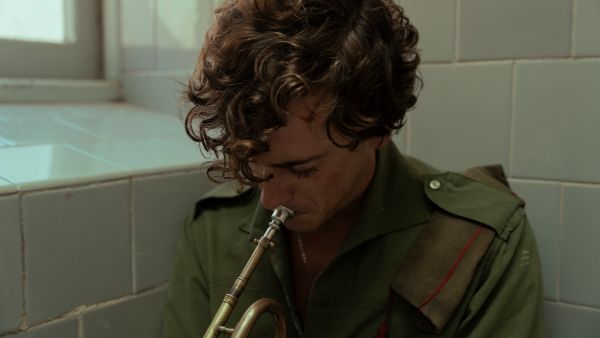
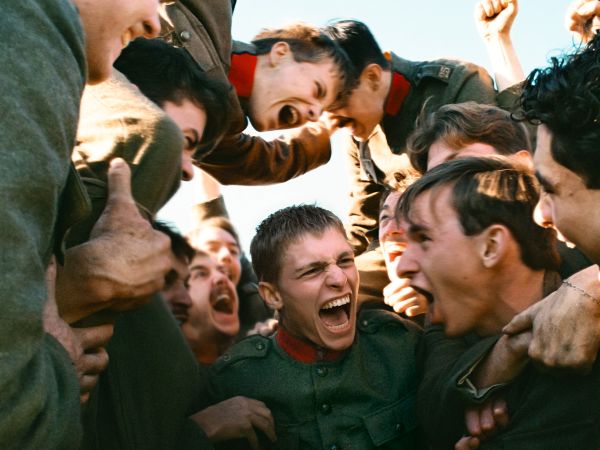
Thus, the intricate and admirable editing work (kudos to Alberto Gutiérrez) links three simultaneous stories about gay men, with inevitable echoes of Stephen Daldry’s The Hours, but on a much grander scale. In 1932, Carlos (Milo Quifes) sets out to apply for membership in an all-male social club in Granada at his father’s urging, only to be rejected by a majority vote of black balls over white ones because of suspicions of homosexual behavior. In 1937, Sebastián (singer Guitarricadelafuente, making his acting debut) is a soldier in the Nationalist faction during the Civil War, having effectively enlisted because he has no alternative after his town has been bombed. Sebastián is occasionally assigned to guard a wounded prisoner of war, Rafael (Miguel Bernardeau), who is recovering in the infirmary before being interrogated and probably executed. A gradual homoerotic connection develops between the two, mediated by the impossibilities imposed by their circumstances. In 2017, historian and former playwright Alberto travels to a northern village to receive a supposed inheritance left to him in his grandfather’s will, a man he knows almost nothing about except that he abandoned his mother, Teresa (Lola Dueñas).
La Bola Negra is filled with breathtaking set pieces and voluptuous camerawork, shot on 35mm film with the distinctive decision to preserve the negative’s curved edges in the projection, lending the image an intentional sense of artifice. Music and dance often give the film an expressionistic quality somewhere between the musical (Penélope Cruz, in a brief appearance, plays a cuplé singer entertaining the troops) and poetic abstraction (snow gradually takes center stage, both literally and figuratively). The image of Sebastián, carrying his trumpet, climbing a toppled statue of Saint Sebastian pierced by arrows, is among the many indelible images that distinguish Gris Jordana’s cinematography. The baroque and muscular filmmaking immediately places Los Javis in the inevitable position of conquering Hollywood, should they wish to do so. (My suggestion would be to adapt a big Broadway musical such as Miss Saigon.) Yet this film has already cemented its place in Spanish cinema, and it is highly likely to be remembered as one of the best of the year.
In any case, La Bola Negra feels like everything cinema can and should be when it dreams big with the right ambition, and an example for future queer filmmakers to follow. For those in the know, it contains a beautiful and richly textured tribute to Lorca’s work. For everyone else, it cuts deep as a lucid lament for lives lived only halfway, or cut short before their time. And for all those who understand firsthand and suffer directly from what this film sets out to express, it serves as a prayer: May the snow never cover the summers we still owe ourselves.





Leave A Comment