
Would we be left speechless by the ending of 2001: A Space Odyssey without Richard Strauss’s Also sprach Zarathustra? Would Nolan’s The Odyssey amount to only half of the grandeur it proposes without Ludwig Göransson’s score? Especially in Hollywood movies, music has always been the not-so-secret sauce that completes the experience for the spectator. But we often don’t stop to think too much about the intricate role a score may play.
Cue Behemoth!, a film that turns music for cinema into its very foundation, and a multilayered tribute that consciously takes advantage of what a movie can achieve through how and when music is implemented. Simultaneously, it invites the viewer to become an active listener to the usually invisible talents behind the music. With its world premiere at the 64th New York Film Festival, this ambitious project marks Tony Gilroy’s return after a 14-year hiatus from directing. (He has remained busy as a screenwriter and producer.) With his fourth film (a short but substantial filmography), the filmmaker writes and directs (and symbolically composes) his best work.
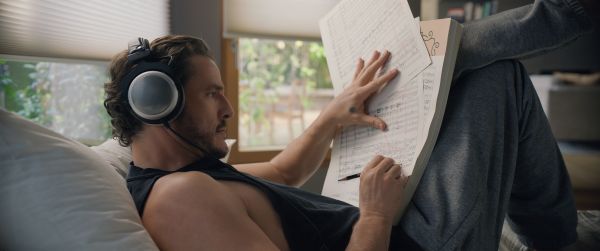
Alex Serian (Pedro Pascal), a renowned cellist and former child prodigy, returns to Los Angeles to participate in the recording of film scores. We see this process, as rarely shown on screen, like an ordinary day “at the office”: musicians sit around the podium that will be occupied by the conductor, NDAs have been signed beforehand, someone in the booth is always diligently overwhelmed or arguing about something, and when the musicians finally begin recording, the rough cut of a movie plays out on a screen in the background. (Behemoth! is the name of one of the movies whose score the orchestra is recording.) The sessions are portrayed as a humble and disciplined collective effort. Alex is just one of the musicians following orders, standing out no more than the others, indifferent to his former fame. Right away, he comes across as an appealing enigma: Why has this man given up the stage and the spotlight to become part of an ensemble?
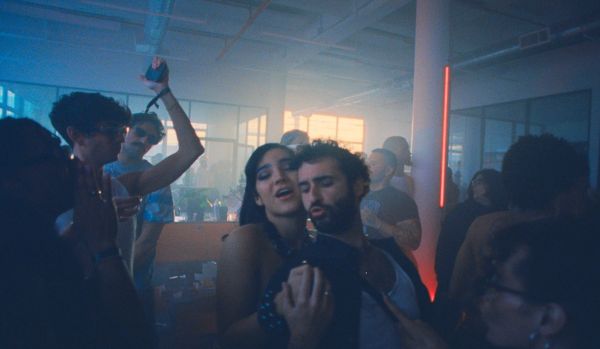
The narrative is not always chronological and unfolds as an almost Memento-level puzzle of fragmented pieces that return to Alex’s present moment and his work in the industry. Along the way, there are two key women in his life: Nadia (Eva Victor), a fellow musician with whom he has a passionate romance that burns itself out; and Carol (Olivia Wilde), a wealthy and always impeccably dressed ex-lover, wife of a patron of the arts, still obsessed with getting him back and capable of reappearing at any moment as a Fatal Attraction–level boogeywoman. Wilde is pure dynamite wherever she appears, reminding us that she can sometimes make an already good movie even more exciting (The Invite and I Want Your Sex), while on other occasions she threatens to overpower a considerably better one (the case here of having one scene too many).
There is also another child prodigy, who later reappears as a teenage genius, in addition to Alex’s ailing mother, and a sibling (Will Arnett) who records podcasts and has learned to live in the shadow of his more talented brother. Two mesmerizing sequences of Alex being pursued unfold with a double level of irony and grandeur, thanks to the accompanying music, which advances the story and Alex’s objectives while dramatically “vocalizing” his inner emotions. Nearly all of the music heard consists of selections from the scores Alex has played for various film projects, resulting in a disparity of moods and tones.
Another search for an answer yields a predictable outcome, making clear that this subplot exists not for a plot twist, but as an emotional reckoning for Alex to click into place at the right tempo. Throughout, there are pauses and crescendos going back and forth, punctuated by music, moving from the diegetic to the extradiegetic. It’s a fresh approach to using music to enhance a narrative while underlining the laborious process behind how it helps tell stories in mainstream movies.
Should I sing its praises? Pascal, for his part, delivers his most arresting and assured performance. Alex exists and wanders, perfectly encapsulating the spirit of the movie, cutting against Pascal’s usual extroverted charisma as an exposed and sensitive man who takes refuge in music to express his emotions. However, the real stars here are the nine composers who make up the Behemoth Collective, among the finest working in the industry today, including James Newton Howard, Alan Silvestri, Michael Giacchino, and Emily Bear.
Behemoth! is a stirring post-musical and a strange meta-melodrama. Better not to oversell it, but Gilroy’s film casts a visual and sonic spell. There is no urgency or important truth too evident here, but rather something that still stays and lingers, almost on the verge of abstraction, anchored by Pascal’s melancholic performance.
Ultimately, this project is fueled and animated by music to the extent that becoming a multi-composer symphony in fragmented pieces appears to be its main purpose. I wonder if it works better on a rewatch. By the time the credits roll, you may want to revisit Behemoth! almost instantly.







Leave A Comment