For her ambitious biopic about Franz Kafka, director Agnieszka Holland refuses to take the obvious route in dramatizing the ordinary existence and extraordinary work of a writer whose very name has become an adjective, even for those who are unfamiliar with his writings.
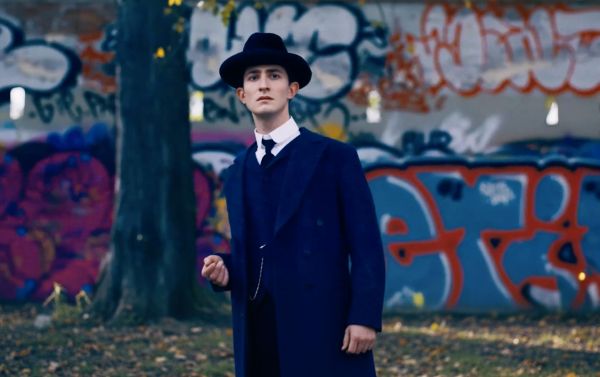
Holland does follow the trajectory of Franz’s too-short life from its unassuming beginnings as a frustrated clerk at a dull insurance office to his death from tuberculosis a month short of his 41st birthday. Franz (played with enormous intelligence by Idan Weiss, a twitchy Kafkaesque lookalike) is unsurprisingly fascinated by alienation and unfeeling bureaucracy, subjects for his future works. However, his artistic endeavors are anathema to his befuddled parents, his brutish father Hermann (Peter Kurth) especially angered by his son’s disinterest in having what he considers a normal career path.
Holland centers her film around the neurotic Franz’s complicated relationships with two women who become muses of a sort. He first falls for the domestic Felice Bauer (Carol Schuler), sending her letters, often several a day. Although her poor family is happy with the relationship, his parents, especially Hermann, are upset that Franz wants to marry someone they consider a peasant. After an affair with Felice’s best friend, he finally breaks off this ill-advised match, then fortuitously meets the liberated (and married) Milena Jesenská (Jenovéfa Boková), with whom he is far more compatible both sexually and intellectually—she later becomes the first translator of his work from the original German.
Holland’s energetic direction unpacks Franz’s rather conventional life and quite unconventional art in ways both illuminating and irritating. Several characters directly address the camera as if giving first-person accounts in a documentary, while a short story like the intense “In the Penal Colony” is re-created in a too-literally blood-dripping manner.
Likewise, intentional anachronisms abound, from Polish post-punk band Trupa Trupa’s music to the sight of modern-day tourists in Prague looking for anything associated with Kafka—who, at one point, notices the presence of a guided tour, an ironic comment on his unlikely posthumous fame. Before he dies unknown, he asks friend and publisher Max Brod (Sebastian Schwarz) to burn his writings after his death, which luckily doesn’t happen—although Holland imagines Brod doing that to emphasize how close we came to not having any of Kafka’s classic works.
These freewheeling flourishes can also be too on the nose in their underlining. The tourist group bits allow the accompanying guides to give reams of exposition about the society Kafka lived in, not once but several times to the point of redundancy. And a moment where the insecure Franz yells at a wounded war veteran begging on the street because he didn’t make change for the two-crown coin Franz gave him, since he only asked for a crown, ends with Franz angrily declaring, “All words have a unique, unmistakable weight,” as if we didn’t already know he believed and lived that axiom.
Holland’s kitchen-sink approach ends up as eccentrically strange as her subject, whether she aimed to accomplish that or not.


Leave A Comment