
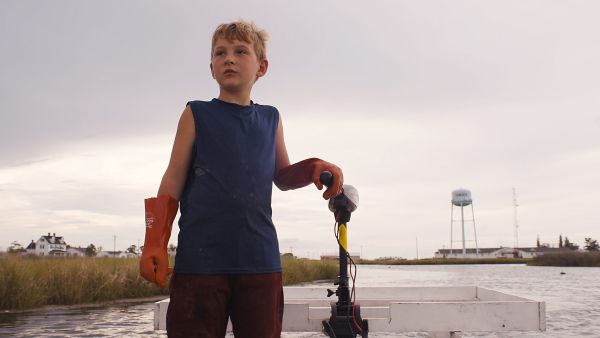
At first, it’s hard not to be smitten by all the beautiful shots in David Usui’s observational documentary. Exquisitely filmed by Peter Steusloff, the film often possesses a Terrence Malick feel in its sensibility. In one sequence, a group of children ride bikes along roads at sunset under pearly clouds. In the opening, the blue of the Maryland blue crab strikingly echoes the rustic, peeling blue paint of the boat where they are caught. But the film doesn’t subsist only on the locale’s picturesque beauty. In fact, it’s more of a sad reckoning with a way of life and a tight-knit island slowly being taken by the sea. A title card notes that over the past 150 years, two-thirds of the island has disappeared.
Tangier Island, located in the Chesapeake Bay of Virginia, has a population of about 400 people and is only two and a half miles long and roughly a mile wide. Usui introduces bits of the island through its people—a boy riding a bike, a woman giving a tour to tourists seated in the back of her golf cart. The town has two churches—bedrocks for its mostly socially and politically conservative residents—a nondenominational church and a Methodist church. The latter is the oldest building on the island at more than 100 years old. Most of the men are “watermen”—crabbers and oyster fishermen.
The town’s mayor, James “Ooker” Eskridge, a longtime crabber in his mid-60s, recognizes the changes around him in town (he mentions kayaking through his front yard when it stormed one year) while also feeling the physical toll of his work; one of his legs is giving out, making it hard for him to stand. Cameron Evans, a twenty-something from the island, is enrolled at Virginia Wesleyan and seems to be at a crossroads regarding his future. Blond, seven-year-old Jacob Parks is one of the children the camera follows through spirited adventures. The Southern accents of the townsfolk are distinctive and unique to the ear, and different inflections emerge throughout, especially generationally. (The dialect seems to weaken among the younger folk.)
There’s a psychological toll, too, in watching the town slowly slip away, especially for those who remember it as it once was—a parishioner at church remarks that she is one of the oldest women left on the island, which sometimes makes her feel sad. In contrast, children joyfully play along the beach, building makeshift sand walls to hold back the water, even as their future feels uncertain. The film also follows aging fishermen at odds with unpredictable weather; it is “always guesswork,” one adds, noting that “the bay gives and the bay takes away.”
Still, the film—and its title, Been Here Stay Here—suggests that many of the townspeople, through their strong faith in both God and their community, will go down with the ship. While many people on the island believe in climate change, most believe that it’s not due to human activity (as noted by one town elder). Government funding for building jetties and other attempts at holding back erosion appears to be in limbo. When a pastor arrives to preach from the Evangelical Environmental Network, an organization that spreads the gospel through an ecological lens, there’s the slightest tinge of suspicion from the townsfolk.
Usui previously collaborated with the legendary Albert Maysles on the wonderful, underseen documentary In Transit, which followed passengers on the Empire Builder train between Chicago and the Pacific Northwest. Here, on his own, he helms another introspective film with a non-judgmental eye. There are lingering shots of Tangier Island’s immense beauty and open skies, the sense of the fishermen’s intense labor, and the painful sights of the leaking ceilings in an abandoned house. It’s a haunting, meditative piece and a contemplative rumination on existence itself.









Leave A Comment