
History buffs, cinephiles, and lovers of the absurd will enjoy Fiume o Morte!, a witty hybrid documentary by Croatian director Igor Bezinovic that intertwines farce and tragedy. Bezinovic re-creates the strange trajectory of Gabriele D’Annunzio, an eccentric Italian poet, seducer, and wannabe general who led a failed invasion of a disputed Yugoslav statelet in 1919—the territory once known as the Italian city of Fiume, now the Croatian city of Rijeka. While his treatment of this bizarre footnote tends toward the humorous, the filmmaker offers some shrewd observations about the dangers of megalomania, ethnic cleansing, and ill-conceived wars without a plan B. Lessons for our time, perhaps?
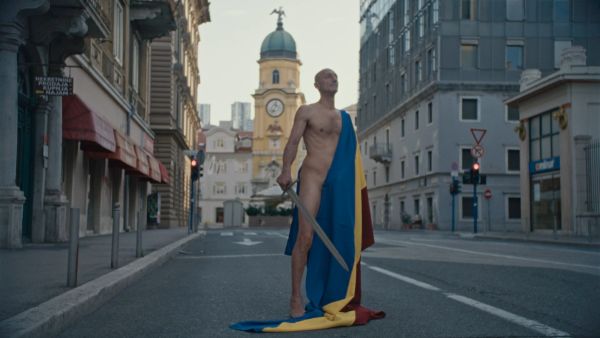
Bezinovic starts the journey by comparing old photos of the coastal town of Rijeka to its present-day state, outlining the city’s passing back and forth between Croatia, Italy, and the old Austro-Hungarian Empire. He asks passersby in Rijeka’s bustling streets whether they remember who D’Annunzio was. Few do, and those who recall him tend not to be fans. “A fascist,” sneers one man. “We needed him like we needed a hole in the head,” says a woman with an accompanying eye roll. But the memories seem to intrigue the townspeople, and the filmmaker pulls off a coup by enlisting the locals to perform elaborate reenactments of D’Annunzio’s quixotic campaign. He holds auditions in a lavish presidential palace and casts multiple bald men to play D’Annunzio at his strutting finest. Soon, faux battles are erupting in the streets, parades and parties are unfolding, and poses are struck mocking the florid mindset of the period.
As a satirist, Bezinovic has a lot of material to play with. In his glorification of ultramasculine athleticism and belief in divine providence, D’Annunzio was a forerunner of Benito Mussolini. Like Mussolini, the short, bald, and nearly toothless cavalier turned an unfortunate physical appearance into a distinctive asset. And also like the dictator, D’Annunzio loved to throw patriotic shade, mocking the town’s “Slavic bastards and their swineherds.” D’Annunzio’s writings reveal a deluded self-image as a savior, hero, and sure winner entitled to seize other people’s land and wealth.
The film revels in sending up this faintly ridiculous figure with a formidable visual vocabulary, unfurling colored images over black-and-white archival footage and staging splendid tableaux of D’Annunzio’s war with the flair of a Wes Anderson or a more light-hearted Roy Andersson. Rijeka’s pragmatic citizens enjoy themselves carrying out the project, too. A woman bursts out laughing in the middle of a wannabe-heroic scene taken from the great man’s autobiography. Another woman chides an uninformed young reenactor holding a dummy gun: “What are you doing here? You should be at a disco with a pretty girl!”
The film can seem like a virtuosic but slightly overextended in-joke, yet it quietly makes room for more serious thoughts. Questions of memory and national identity emerge in interviews. The tone grows grimmer as the story depicts D’Annunzio repressing the local population and withdrawing his forces in disgrace. What began as a dashing lark ended in real deaths, skillfully represented here by bloody “corpses.” Years of disputes over the town followed, and residents now reflect on the traumas of communism and deindustrialization. Fiume o Morte! starts out as a zany romp, but a dark past catches up to it—a fitting parable for history, conquest, and perhaps life itself.






Leave A Comment