
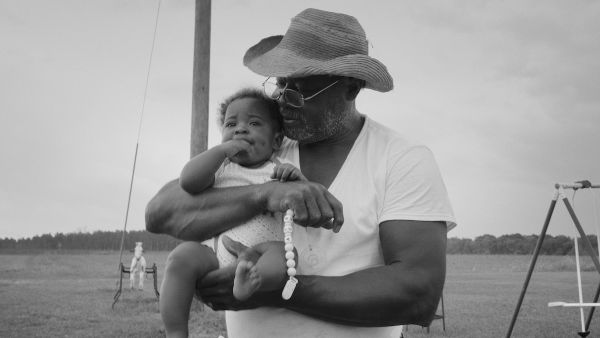
Lyrical and immersive, Brittany Shyne’s documentary is a stirring portrait of the ordinary, day-to-day working lives and experiences of Black farmers in rural Georgia. Shot elegantly by Shyne in black and white, the quiet intimacy of her camera almost feels as if it is from the point of view of a friend or a member of the community.
In some respects, the documentary is reminiscent of RaMell Ross’s atmospheric and poetic Hale County This Morning, This Evening. It also echoes Raoul Peck’s North Carolina–set Silver Dollar Road, which is more of a traditional, talking-head documentary, but one that similarly messages the plight of preserving multigenerational Black-owned land, especially in the American South. The film provides neither name titles nor narration. You mostly follow its subjects by their faces, a mix of ages from the eldest patriarchs to the youngest—a baby who loves to sit in the open, patting his hands on the grassy land.
Shyne’s film intently observes and listens to laconic conversations and the lull of its natural landscapes. Who knew the simplicity of a scene of an elderly woman quietly washing her hair in a kitchen sink with Pantene could be so compelling? After drying it, she asks Shyne to feel it, further establishing that sense of the camera and the cameraperson as one of their own.
Music rarely intrudes, and when it does, it is a strand of music on the car radio (the melancholic sense of time passing in Frank Sinatra’s “It Was a Very Good Year”) or the muted electronic tones from composer Robert Aiki Aubrey Lowe. Sometimes the score effectively blends into diegetic music, such as gospel music performed at a funeral. Often, the film is tuned into the rhythms of mechanical sounds as well—the hum of car engines or the metallic, grinding sounds of a cotton-sorting machine.
The film is direct and impactful about economic struggles, highlighting both large and small details. A car window does not roll all the way up. A house is found to be propped up on cement blocks only on the perimeter of its frame, causing the structure to sag in the middle. When one of the men needs to pay almost 200 dollars for a new pair of glasses, you sense the strain of being able to afford them. Farming, including using pesticides and maintaining equipment, is expensive, especially for those just barely getting by. Illuminating the ongoing struggles of long-baked discrimination against Black farmers, the documentary features the community gathering to protest in front of the White House, demanding the release of promised funds from President Joe Biden’s 2022 Inflation Reduction Act.
Akin to its title, the film references the cycle of life in plants and humankind. For a farm owned by families for over 100 years, one wonders about the future of their way of life: Will the grandchildren and great-grandchildren want to carry on both the pride and the burdens of maintaining their generational land? From the opening scene of a little girl in the backseat of a car asking about heaven and naming all the relatives she knows who are buried in the family cemetery, to an elderly man talking about facing mortality, the film makes a memorable, compelling, and cyclical journey.






Leave A Comment