

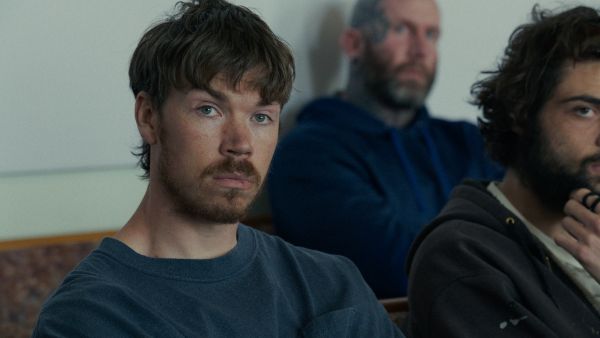
Delicate and tender, Max Walker-Silverman’s rural Colorado-set drama follows a divorced cowboy, Dusty (Josh O’Connor), in the wake of losing his family’s ranch to a deadly wildfire. He is unable to obtain a loan from a bank (the severe burns on his land make it impossible to return to ranching), and he might move to a ranch in Montana with a brother. In the meantime, he moves into a FEMA trailer on a plot of land shared with a few other trailers of displaced people. In their serene, I’ve-got-your-back existence, the group help each other out—making a meal for someone, hooking up running water.
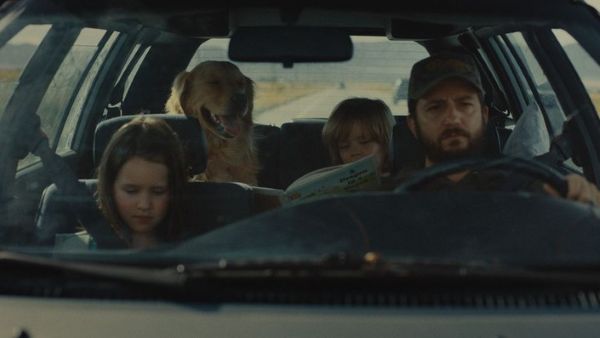
Meanwhile, Dusty has visits from his young, grade school-aged daughter, Callie Rose (Lily LaTorre), who looks up to him and lives primarily with her mother, Dusty’s ex-wife Ruby (Meghann Fahy), with whom he has a genial relationship. Ruby lives with her ailing mother (Amy Madigan) in a nearby town. A library there is the closest place for rural residents to access Wi-Fi. It usually closes early, so at night Dusty takes Callie Rose there so she can read books on her tablet, in the bed of his truck in the parking lot. Later, when a couple from the group of trailers tries to apply for assistance, told they are only able to do so on a phone by an unhelpful government worker, Dusty and Callie Rose aid in filling out their application.
The inadequacies of the banks and government, and the implications of climate change are the main sources of conflict, and linger mostly outside of the frame. (Dusty imagines if he were to rebuild another home on his old land, it would survive, at best, another 20 years.) It’s unusual to see a film where interpersonal relationships, despite trying times at hand, are kind and overall, strife-free. It’s unclear even why Dusty and Ruby ever split, perhaps just a natural drifting apart.
O’Connor excels in taciturn roles. Ubiquitous in an array of indie films over the past few years, it was almost distracting at first to see him here. I wondered, am I just seeing his slippery J.B. Mooney character from The Mastermind in cowboy drag? But quickly he disappears into the role, his demeanor and accent work lived-in and authentic. It’s also disarming initially to see Madigan, so warm and subdued, after so thoroughly embodying the kooky cult horror character Aunt Gladys in this year’s Weapons. The well-cast LaTorre is natural and low-key, and one could even see a resemblance a bit with the family. Also notable is Kali Reis, who, in addition to being an actress and a standout from True Detective: Night Country, is a professional boxer. Despite a thinly written part, she brings a formidable presence to the role of Mali, who lives in one of the FEMA trailers and befriends Dusty. Ruby and Mali recede a bit in comparison to others here, but perhaps that’s purposeful, as it’s told mostly though Dusty’s perspective.
Like his previous effort, A Love Song, which featured the excellent Dale Dickey and Wes Studi as reunited friends, Walker-Silverman’s film revels in its rural landscapes and genteel atmosphere. There was a sense of thorny ambiguity between the two characters in the earlier film that lacks a little here overall. Unlike many movies this year, refreshingly at 95 minutes, it isn’t overlong, but it loses some steam halfway through. This could be due to Dusty’s relentless restraint, but also its flat, visual look. Nevertheless, the gentle guitar score by Jake Xerxes Fussell and James Elkington figures pleasingly throughout, and the John Prine song “How Lucky” blends beautifully into one sequence, as a sort of theme song for Dusty.
Despite its seeming simplicity, this is another contemporary American feature where one is confronted with the plight of marginalized people in the wake of tragedy. In a noisy, divisive country, people behaving nice and helpful to one another, despite chaos, seems novel these days, perhaps even groundbreaking.




Leave A Comment