

A shimmering jewel at the recent New York Film Festival, The Currents by Argentine writer/director Milagros Mumenthaler, elegantly captures the interior world of a 34-year-old woman following an incident that upends her privileged life.
To the applause of colleagues in Geneva, Lina (Isabel Aimé González-Sola) accepts a fashion design award, then promptly disposes of the crystal trophy in the ladies’ room. She then wanders the city alone, her smart blue coat contrasting with the gray cobblestone streets and autumn leaves underfoot. In what appears to be a spontaneous act, she plunges off a pedestrian bridge spanning the churning currents of the Rhône, and then yields to the water’s pull.
Next, she has been rescued and returned to her hotel in a shimmering gold Mylar blanket. Back home in her well-appointed abode in Buenos Aires, she’s emotionally altered, overcome by a phobia for water and is unable to shower. Title credits roll after this powerful, wordless opening that sets up the restless condition she navigates despite a successful career, dedicated husband, and loving child.
She works hard to conceal her private struggles, but her older husband, Pedro (Esteban Bigliardi, The Delinquents), notices something is amiss, that she’s distant and moody. “It’s like you never came back,” he says. “Yes, I came back,” she replies and initiates lovemaking. Nevertheless, she had already told him in passing that she doesn’t want him to touch her hair, which she hasn’t washed in days—the spectacular brunette mane fairly defines her beauty. A close-up of her hair streaming off the back of a sofa is one of the striking visuals. Gorgeous aesthetics distinguish the entire film.
Lina seeks out an old friend, Amalia (Jazmín Carballo), a salon owner, to wash her hair and sponge bathe her, but first needs sedation to get through it, to avoid being retraumatized by enveloping water. This is a temporary fix for her existential crisis, as are exposure therapy and a virtual reality experience with a headset placing her in a rainy day in the mountains while she is actually indoors.
Lina and her mother haven’t seen each other in years, and their encounter is a clue to the former’s mental state. Her mother, Nadia (Sara Bessio), appears to have a fear of contamination and lives in a modest home with plastic-covered furniture and a shelf full of medication—Lina sanitizes her hands on entry into the house. Nadia refers to her daughter as Cata (as does Amalia), shortened from Catalina, hinting that the present nickname is part of her glamorous new life, although now it’s part of her façade to hide an unsettled disposition.
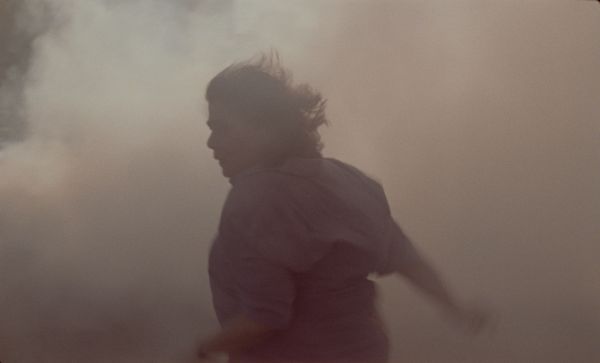
When Lina follows her five-year-old daughter (Emma Fayo Duarte) as she rebelliously runs up a lighthouse (reminiscent of the bell tower in Hitchcock’s Vertigo, a visual reference for the film), she looks down on the city and sees—or hallucinates—her friends and neighbors commuting, dating, and enjoying easygoing evenings, as illuminated by the spotlight. González-Sola is captivating in these surreal moments, as well as in depicting Lina’s quotidian life, the sum of which create an internal and external portrait.
As an insight into this sequence, Mumenthaler asserted in the press notes that the story for this, her third feature, was inspired by Virginia Woolf’s Mrs. Dalloway, also about a fictional upper-class woman. She was particularly stirred by “how the novel flows through the protagonist’s consciousness and shifts from one character to another.”
Exquisite lensing by cinematographer Gabriel Sandru is fitting for a stylish world of fashion, art, and galas. He telegraphs mystery through reflections—Lina sees herself dressed as someone else through a shop window or her image is mirrored in glass against a cityscape. The early scene of her falling into the river is shot at such a distance, it’s impossible to tell what exactly happened.
An odd and playful sonic atmosphere by Carlos Ibáñez Díaz reinforces the disassociated mood. Classical pieces and single instruments alternate with environmental noise, such as a jackhammer or human breathing. Sound moves in and out in a dream-like way, emphasizing that recovery from a destabilizing trauma is elusive.
At the time of this writing, The Currents is seeking U.S. distribution.







Leave A Comment