
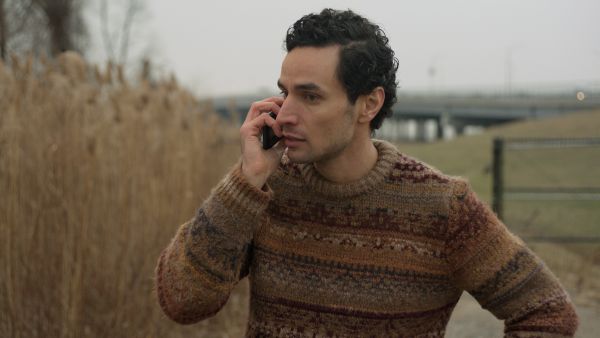
Ali (Adam Bakri), a young Iraqi doctor, is on a path toward asylum in the United States. He lives with Katie (Jess Jacobs, who also co-wrote the script), the owner of a scrappy New York City art gallery. Everything seems to be going well until his longtime friend is kidnapped in Iraq and a ransom is demanded, on the assumption that Ali has become wealthy in the States. However, he keeps Katie in the dark about his machinations to get money for the kidnapping, straining their relationship. This also threatens to jeopardize Ali’s asylum application. Further stress is added after Ali performs an illegal operation on an undocumented girl: He doesn’t have a license to practice medicine in the States.
That is the sum-up of If You See Something in a nutshell. Its themes run deeper—assimilation, discrimination, the nature of families—but the plot itself is quite simple. It is heartfelt and generous to its characters and, indeed, a well-made, modestly budgeted independent film. It just isn’t too revealing. Its attempt to capture a slice of life actually minimizes much of the conflict. This works occasionally, as when Ali visits Katie’s family for his first Thanksgiving dinner and faces an onslaught of microaggressions. But for the most part, the tension is downplayed to a fault. Emotionally charged scenes are conveyed subtly; the score is subdued.
It’s possible, though, that the tone purposely reflects the mindset of Ali, who is a singularly passive character. Bakri portrays him as a quiet, polite, respectful person who keeps every emotion close to the vest. However, the script never quite allows us to see what is going on inside. The other actors fare better, especially Reed Birney as Katie’s father and Hend Ayoub, the mother of the undocumented girl Ali operates on.
The most interesting aspect is the contrast between the two families: Katie’s and the Iraqi family that Ali helps. Both are loving and wary of strangers, but for different reasons. Katie’s father is suspicious because his daughter is dating a man he barely knows from another culture. Meanwhile, the Iraqi family helps Ali facilitate the transfer of the ransom. Ultimately, Katie faces a choice between the two.
The conflicts resolve largely as one would expect. There are few surprises, yet the low-key film does have heart. It has something important to say about how we treat immigrants—both undocumented and those who aspire to citizenship—which is a rarity these days.










Leave A Comment