“All my memories are movies.” “That’s what movies are for us… pieces of time.”
This dialogue might seem corny in a film about the life of an aging movie star having a conversation with his former mentor. Yet the inherent artificiality of the exchange feels just right. The scene, set in an immaculate kitchen, establishes that even in his most intimate daily life, a movie star remains trapped in a fantasy world. Everything looks like a set, and he speaks and acts like he’s still on camera.
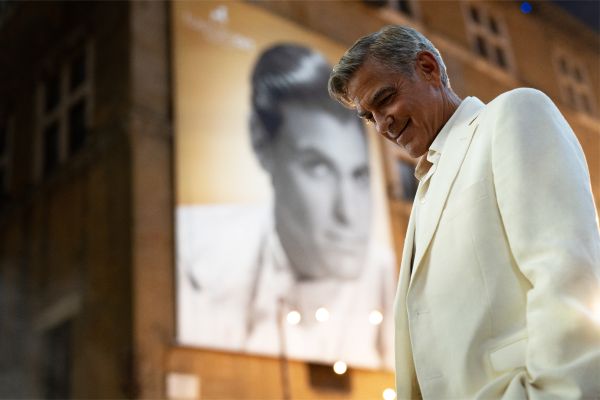
Screening as part of the Main Slate of the 63rd New York Film Festival, this Netflix-backed movie arrives with pedigree—in front of and behind the camera. But don’t be fooled: It’s far richer and more complex than you might expect. Jay Kelly is both the name of the fictional star and the film’s title. Directed by Noah Baumbach with a script co-written by actress Emily Mortimer, the lead actor adds a third, implicit author. George Clooney is Jay Kelly, in a role that seems tailor-made considering his fame and biography. Kelly is also Clooney, a tribute to his longevity as a capital Movie Star.
Everybody knows and loves him—so long as they aren’t close enough to be deeply wounded by him. In the opening scenes, Jay inhabits a film set. He plays a dying man agonizing at the edge of a bridge, with only his dog for company. But what matters is that he delivers it as Jay Kelly, an actor who rarely gets a second take to “do it better.” One starts to wonder how much of Clooney’s own acting experience bleeds into this role. The central casting choice makes all the difference; it would hardly be as good—or as effective—with anyone else. Or perhaps that’s just the elusive magic of true stardom, and Clooney embodies it perfectly, making us believe the movie wouldn’t exist without him.
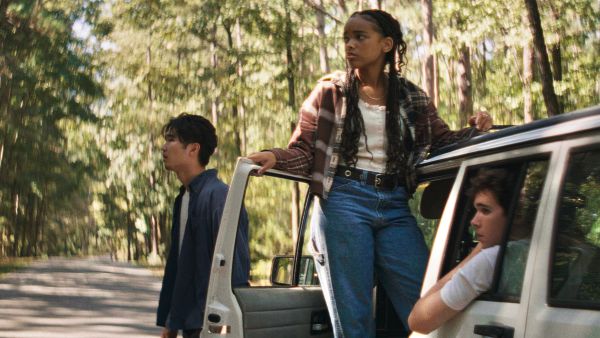
Jay has begun to think too much about the abandonment and damage he’s caused along the way. Maybe it’s too late for regrets, much less to make amends. His relationship with his eldest daughter, Jessica (Riley Keough), seems practically unsalvageable. On a recent visit, Jay walked out of her therapy session when her psychologist was set to read him a letter cataloging his failures as a father. Things are less dire with his youngest, Daisy (Grace Edwards), but she’s about to start college and has a summer trip planned in Europe with friends. Wanting to spend more time with her, Jay hatches a plan to “coincidentally” cross paths by accepting a tribute at a small Italian film festival, despite having once sworn he’d never attend such an event.
Jay’s journey provides the film’s physical and geographic framework, but the emotional journey is one of progressive shedding—not only of his usual entourage but also of his own memories. Baumbach embraces an expressionist vein that veers away from his tightly written family dramas, full of existential crises. Instead, he confirms the departure already hinted at in White Noise (2022). He has positioned himself among contemporary directors with a commanding vision. If his previous attempt felt excessive, even desperate in its ambition, Jay Kelly is more confident.
With inevitable echoes of Fellini’s 8½ and All That Jazz, Jay drifts through memories like a spectator of his own films. He relives, for instance, how his younger self “won” (or stole) a role during an audition from his friend, the most talented actor in his class. In the present, that same ex-actor (Billy Crudup) declares his hatred and resentment when they meet again. Redemption may seem impossible, and yet there are hints that not everything has been in vain. Wherever he goes, strangers light up in his presence. One passenger says that seeing him feels like watching his whole life flash before his eyes. Another begs him never to grow old because that would mean he himself has aged. A movie star—the truly great and unavoidable ones—becomes, for their audience, a measure of time on earth.
Clooney puts to good use years of recognition as a bona fide star and his natural aging to embody Jay. Unlike his contemporaries, he’s always been content to play a kind of masculine star who now feels like a relic—closer to Clark Gable and Cary Grant than to Tom Cruise or Leonardo DiCaprio. In a way, Baumbach crafts a tribute to Clooney’s body of work and also to an old-fashioned mode of stardom that today seems extinct. In a character study that feels at once self-deprecating and self-indulgent, Clooney is transfixing. However, the impact of his performance is deepened by Adam Sandler’s turn as Ron, his loyal, long-suffering manager—the last man standing in devotion to a myth. It’s one of the best supporting performances this year, and every scene shared with Clooney is a marvel.
Don’t let the apparent ode-to-cinema tone fool you. With a sly undercurrent of darkness, Jay Kelly is more bitter than sweet—an examination of fame, of the toll movies take on those who “sacrifice” their lives for our enjoyment, and of the inherent loneliness of movie stars turned symbols. It’s also the film of an actress proving herself as a screenwriter, a writer asserting himself as a director first and foremost, and two divergent stars finding new pathos in their work and revealing overlooked facets of their talents—thus moving us more than ever before.


Leave A Comment