
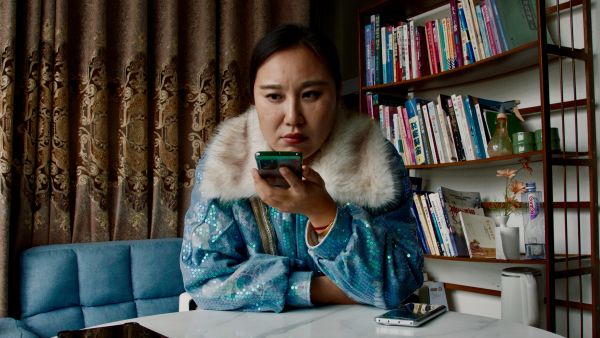
In China, according to Elizabeth Lo’s fascinating documentary, instead of counseling to repair a marriage damaged by infidelity, an aggrieved wife will seek out the help of a “mistress dispeller”—for an often-large fee that could total in the tens of thousands of dollars. This relatively new occupation is something of a cross between a detective and a psychiatrist, someone who goes incognito to track down the offending husband’s girlfriend and convince her to end the relationship.
In a program note, Lo says that there are hundreds of ads for such dispellers in Chinese newspapers, and she and her production team contacted dozens of them before deciding on Wang Zhenxi, who was contacted by the brother of Mrs. Li, a middle-aged wife whose marriage is on the rocks thanks to Mr. Li’s affair with the much younger Fei Fei. All four principals signed off on having their conversations filmed, and the bulk of the movie consists of Lo’s filming their intimate interactions.
Wang first sits down with the couple at their home for a three-way conversation that ends with Mrs. Li becoming angry and storming off because her always taciturn husband—who has never had much to say, according to her—is not forthcoming about his indiscretion. (She discovered it only through texts on his phone, and he, of course, lied about it at first.) Wang told her privately beforehand to leave early on, so she can speak to Mr. Li alone. After she leaves, Mr. Li opens up (slightly) to Wang about his marriage: “We don’t have much to talk about these days.” Lo’s camera (she is her own cinematographer, as well as co-editor/co-writer with Charlotte Munch Bengtsen) records this long back-and-forth in a single medium shot at the table. The director has explained that she left the subjects alone and let the camera film their interactions without her being present, since intensely personal discussions deserved privacy and less inhibition.
Wang then tracks down Fei Fei. Their enlightening conversation includes Fei Fei recounting how she and Mr. Li fell in love, saying matter-of-factly that it’s neither person’s fault. She also confesses that she feels that she doesn’t deserve “complete love,” which may be why she is attracted to “unavailable men,” with whom she feels safer.
Finally, since all have agreed to see this through, Wang brings Mrs. Li and Fei Fei together for what becomes a tempestuous showdown. The aggrieved wife admits that she would have liked to throw a cup of tea at her husband’s girlfriend, “but I’m not that type of person.” When Fei Fei counters that she knows martial arts, it’s pretty funny since it’s obvious that neither woman will raise a hand to the other.
For some viewers, marriage counselors and couples therapy might be considered the usual route in healing marital rifts; hiring a professional to save a marriage might seem strange, even comical. (An amusing rom-com is begging to be made about it.) But, as Lo persuasively captures, cultural norms in China have evolved so that saving a marriage through hiring a mistress dispeller who can chase away a husband’s mistress is considered the more pragmatic choice. This beautifully observed, enormously sympathetic portrait underlines that idea.






Leave A Comment