
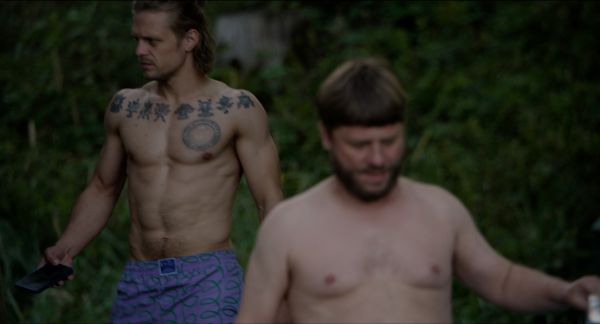
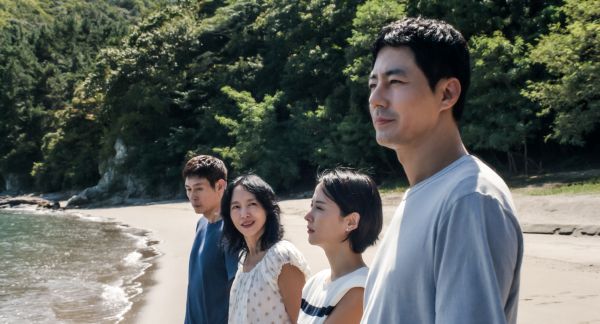
Drowning Dry—a moody, intriguing picture from Lithuanian director Laurynas Bareisa—introduces us to two couples who do not seem particularly happy. One pair is Lukas (Paulius Markevicius), a mixed martial arts fighter, and Ernesta (Gelmine Glemzaite), who, when Lukas impressively wins a competition, remarks that she wishes someone would beat him so he’d stop fighting. The other couple is Juste (Agne Kaktaite), Ernesta’s sister, and Tomas (Giedrius Kiela), a trucker who approaches his wife naked only to be flat-out rejected and told he needs to “try harder.” These dynamics are far from promising.
Still, it’s debatable whether either couple is on the verge of breaking up; after all, they’re taking a joint vacation to the sisters’ lake house to celebrate both Lukas’s victory and Tomas’s birthday. Lukas and Ernesta have a young son, Kristupas (Herkus Sarapas); Tomas and Juste have a slightly younger daughter, Urte (Olivija Eva Viliune).
Throughout the weekend, a quiet tension lingers. The sisters visit a nearby friend, deliberately leaving the men in charge of the children, and return drunk. At Tomas’s suggestion, the men spar, even though Lukas is clearly and embarrassingly superior in both build and skill. The children either stare at screens or act out by throwing toys and earthenware against the wall (they actually seem to get along better than any of the adults, except for the sisters themselves). And then disaster strikes—but not in a way we immediately see or understand. The film skips forward in time and loops back, revealing everything around the incident before finally letting us witness it.
If this makes Drowning Dry sound like a soap opera—or perhaps a Baltic Who’s Afraid of Virginia Woolf?—know that the film is actually marked by stillness and patience. Bareisa’s aim is to extract the most he can from small moments, and the film is full of striking visual compositions, lifelike, carefully chosen details, and most importantly, a cast capable of animating the scenario with life and meaning. The children are especially convincing in the unapologetic way they insert themselves into adult conversations. Likewise, the couples feel achingly real in their moments of private tension. The traumatic events at the story’s core are powerful not because we witness them fully, but because we don’t. Even the emotional aftermath is understated.
Drowning Dry is, at heart, the story of how the two sisters—through different but not unrelated paths—become single mothers. A somber tone pervades. It’s not overbearing exactly, but Bareisa emphasizes dissatisfaction to such a degree that one could argue the film is oversaturated with it. Some viewers may find it too subdued.
Nevertheless, Drowning Dry succeeds—though it is by no means easy viewing. Its strength lies in Bareisa’s quietly commanding direction, his sensitive use of stillness, and a cast that renders the unsaid and unseen achingly vivid. He embraces people in flux, letting gaps in the narrative speak volumes. The film’s power comes not just from what happens, but from the aftermath. Everyone’s response to the traumatic is engrossingly—and sometimes unsettlingly—unresolved.
The title refers to a condition in which breathing remains difficult long after a near-drowning incident. It’s an apt metaphor for the film’s haunting effect: the sense that trauma doesn’t depart, but instead lingers—just beneath the surface, ready to surface again at any moment.




Leave A Comment