

The intensity of first love is piercing and desperate, especially if it is unrequited. Being new for those who are young and inexperienced, it feels unique and unprecedented. Yet when it is shared as a confidence, it may not be perceived the same way by those hearing about it. This crucial ambivalence sustains the narrative richness of Dreams, the latest entry in Norwegian director Dag Johan Haugerud’s trilogy “Love, Sex and Dreams.”
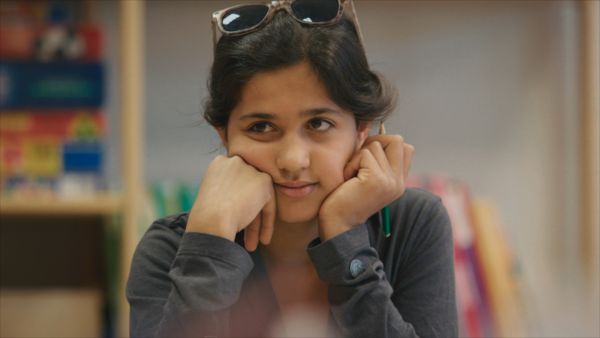
Those who haven’t seen the previous films don’t necessarily need to catch up, since this is an anthology of stories connected by themes, symbols, and the city of Oslo. Each installment has its own set of characters and actors (one single exception, a near-Easter egg for those who watch them all). Dreams centers on the experiences of Johanne (Ella Øverbye), a high school student who knows nothing of love beyond what novels describe—until suddenly she finds herself feeling the very thing literature has been lamenting and singing about for centuries.
The earlier films in the trilogy maintained an omniscient gaze, but Haugerud dares to anchor this particular story in subjective points of view, including unreliable narrators, while confronting the interplay between fiction and memory—a partially shady indictment of the currently fashionable autofiction. In that sense, Johanne’s voice-over guides us through her past experience with her teacher, and what may or may not have happened between them. That same story later transforms into her debut novel, which she writes as a way of preserving the memory of something she describes as “very painful, but mostly wonderful.” What we see is the way it is retold in the novel with its fantasies and omissions, and a subsequent retelling at a therapy session, now affected by time, distance, and the opinions of others.
Haugerud beautifully captures the anxiety and obsession that come with being in love for the first time, the kind that later becomes more measured and self-conscious as we grow older (and, as the script suggests, we do grow older thanks to the mistakes and excesses of that very experience). For Johanne, every trait, every gesture of the beloved is amplified through the lens of idealization, while the slightest sign of indifference becomes a source of bitter anguish. It is almost like a sapphic version of Goethe’s The Sorrows of Young Werther—but without the tragic resolution. What we see of Johanna, in her classes and her interactions with students, reveals charisma and warmth consistent with Johanne’s infatuation. After nights of crying and a few skipped school days (pretending to be sick), the student finally gathers the courage to walk through the city at dusk until she reaches her teacher’s apartment and confesses her love. The tearful girl is welcomed with an embrace when the teacher opens the door, and a fade to black leaves us wondering what might happen between them.
Haugerud revisits that moment later, but first places us in a time when Johanne has completed a manuscript focused less on what happened than on how she felt. Part of the relief of telling a story lies in finding an audience for it, and in Johanne’s case, she first shares it with her grandmother, Karin (Anne Marit Jacobsen), a published poet who intuitively understands the situation. She consoles her granddaughter’s feelings but also appreciates the writing as something that can be read by others. Inevitably, the story also reaches her mother, Kristin (Ane Dahl Torp), who is less understanding, initially fearing her daughter might have been a victim of an unequal situation. Still, in what we’re shown, no dangerous line appears to have been crossed. Even so, Haugerud leaves enough space for speculation the possibility that not everything seen and narrated is all that happened. By respecting that mystery, viewers figure out for themselves the potential revelations and omissions. In any case, it’s refreshing that Haugerud avoids a moralizing narrative, and instead respects the independence of thought and the emancipation that follows a romantic and sexual awakening, which often begins and ends as an individual journey.
Winner of the Golden Bear in Berlin, this new installment maintains the observational sharpness in portraying human relationships that we have already seen in Love and Sex. It also shines for its immersive dialogue, turning every conversation into an opportunity to peel back the layers of complexity that define its characters—and in which we also recognize our own certainties and contradictions. The director allows small extravagances as well, like the recurring motif of a long staircase and a dream sequence that finally makes striking use of it. Haugerud is the kind of filmmaker who, above all, behaves like a dramatist. (He was an acclaimed novelist in Norway before turning to film). He nonetheless avoids turning his stories into static or overly theatrical pieces. He plays with shifting perspectives and has an instinct for when to leave the audience in suspense about what happened and when to return to the moment from another angle. As a result, Dreams emerges as the most cinematically accomplished of this three-part project, one that absolutely deserves to be experienced in its entirety.





Leave A Comment