
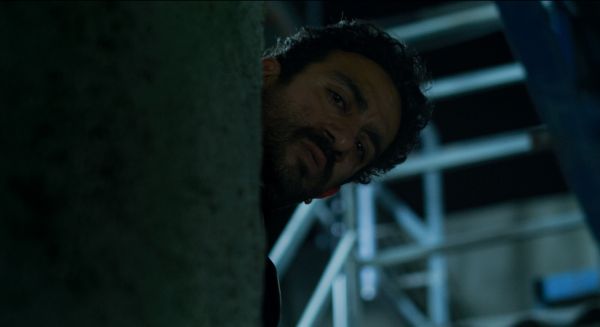
Enduring decades of harassment and imprisonment by the Islamic Republic of Iran’s government, Jafar Panahi bravely continues to write and direct films that reflect the darkness of an oppressive yet resilient regime that has lasted longer than any observers predicted. Panahi doesn’t offer simple, didactic social dramas; he adds a twist of irony, a glint of meta, or something odder to make his movies sprightly and unpredictable. His current work, It Was Just an Accident, recently made a stop at the New York Film Festival on a victory lap after winning the Palme d’Or at Cannes. Panahi takes a revenge tale rooted in Iranian political repression and layers on a shaggy dog story, satire, and notes of dark comedy. Whether these disparate elements work together will lie in the eye of the beholder.
Driving with his wife and child at night in the countryside, middle-class and middle-aged Eghbal (Ebrahim Azizi) strikes a dog with his car, then manages to steer the damaged vehicle to a repair station. There, the mechanic—small, put-upon, and bent over from an injury—shrewdly notices the driver, not by sight, but by detecting the creaking sound of a prosthetic limb. He has identified the impatient client as Peg Leg, the jailer who once tortured him as an enemy of the regime and left him with a permanent stoop. Vahid (Vahid Mobasseri) gives chase in his van and follows Eghbal into the city. In a harsh sequence, he briskly captures his former tormentor and drives off into the desert, where he busily inters Eghbal in the sand as his victim howls for mercy.
After examining his captive’s lesion-blotched leg stump in a rather graphic, nasty scene, Vahid can’t be quite sure that Eghbal is the right prey. He hustles the miserable abductee into a coffin-like box and drives him around chaotic Tehran in search of fellow prisoners for corroboration. He encounters a motley crew of former inmates: a high-class, unveiled woman wedding photographer; the gussied-up couple whose pictures she’s taking; and a hotheaded cynic. Furious arguments erupt over the captive’s identity and what to do with him as the group haphazardly rides around town. Corrupt cops, suspecting funny business in the van, skim money from the party. We are presented with a picture of a society fractured by memories of cruelty, struggling to sort out the past.
Panahi’s directorial touch is as nimble as ever, but a couple of factors may block unalloyed satisfaction while viewing Accident. Early on, Panahi dangles a question of mistaken identity: Is the man Vahid and his companions have captured actually their torturer from long ago, or someone else? He may not be their man. The spectacle of the possibly innocent stranger being buried alive, sealed in a coffin, and harshly worked over as his tormentors debate whether he’s really the bad guy will give some viewers pause. Perhaps the scenario is meant to score the point that the desire for revenge overrides rationality, but it still makes for a pretty queasy sight. Gags like a careening van in traffic, a vomit-enhanced faceplant, borderline-slapstick squabbles, and a pregnant woman’s rush to the hospital add an antic note that feels lively at some junctures, facetious at others.
Another issue is a lack of immediacy. Panahi’s recent No Bears, follows a chill, sophisticated film director (played by Panahi himself) arriving in a remote village. Narrow-minded small-town types immediately target the outsider and implicate him in village beefs. A sense of danger mounts minute by minute as the urbanite vainly tries to extricate himself from pointless yet all-consuming quarrels. By contrast, Accident’s revenge-seekers recall the torment that took place in the past. We’re told but not shown, and for some of us, the impact just won’t be as strong.
It Was Just an Accident’s last few frames depict a moment of trauma relived—the sense that no matter today’s outcomes, some kinds of damage can’t be undone. It’s a moment of sobriety the film may have earlier steered too clear from. It packs a hard blow.





Leave A Comment