
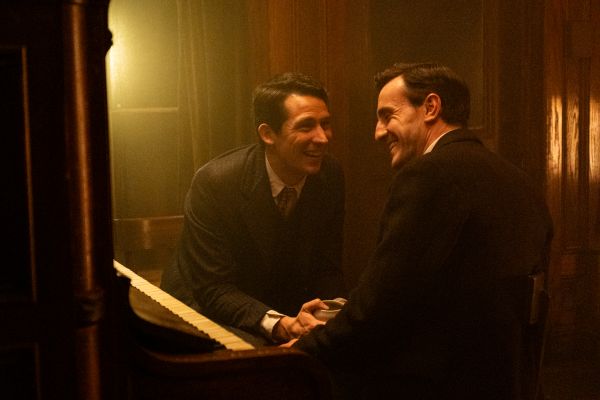
Every gay-themed—or queer-adjacent—work seems tacitly obliged to break new ground and push the envelope, especially when flirting with Hollywood-style production values and featuring would-be movie stars. That said, it’s easy to see why, at first glance, a romance of silent passions and melancholic restraint like The History of Sound might feel reactionary, a missed opportunity. Even more so when it includes straight actors playing gay characters: Paul Mescal and Josh O’Connor. Indeed, moments of physical intimacy between the protagonists are minimal and mere illustrations of their bond, infused with a narrative that privileges yearning over possession.
And yet, Oliver Hermanus’s film doesn’t need to be revolutionary. Set in the early 20th century, two musicologists fall in love while carrying out an absorbing folk music research project. In fact, if we allow ourselves to become immersed in its sinuous rhythm, it produces a devastating effect on par with Brokeback Mountain or In the Mood for Love. It’s also worth remembering that Hermanus and his leads have already paid a fair share of gay duties to cinema: the South African director with Moffie, Mescal with All of Us Strangers, and O’Connor with God’s Own Country.
Leaving aside the aforementioned burdens and expectations, The History of Sound is a contained, modest film that rewards you with one of the most memorable love stories of the year. Based on a pair of short stories by Ben Shattuck and adapted by the author himself, the film begins in 1917. Two students from the Boston Music Conservatory form an instant bond through their shared devotion to music. Farm boy Lionel Worthing (Mescal), born and raised in Kentucky, has left behind his precarious home—at least temporarily—to pursue an academic education, a mirage in difficult times. He has a particular gift: not only his pristine voice, pleasant to the ear, but also a special condition in which he perceives music with all his senses (what might be described as synesthesia). An orphan from Newport, Rhode Island, David White (O’Connor) has had a wealthier upbringing and also stands out for his exceptional musical memory. He’s able to play and sing a song after hearing it just once.
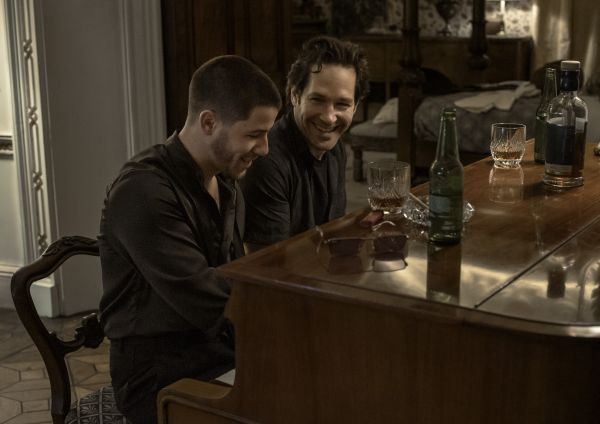
They first meet in a bar frequented by students. Lionel approaches David when he hears him singing at the piano a familiar tune from his childhood. When Lionel takes his turn to sing, the scene unfolds with a sharp intimacy, as the world around them collapses into the pure act of listening and their mutual appreciation of something as elusive as music. Mescal, trained in musical theatre, is disarming every time he performs a song. The evening continues in David’s room where, a little drunk, they tease each other, sharing a single glass of water until David spits it out and Lionel catches it in his own mouth. This is enough to signal a mutual physical attraction ready to be consummated. The next morning Lionel wakes to find a note on the bed and David gone, but with a promise intact: they will see each other again the following weekend. Thus begins a relationship abruptly interrupted when David is drafted into World War I.
Fortunately, the lovers reunite after the war, and David proposes a special project: collecting folk songs throughout rural Maine as part of an academic research initiative. The goal is to meet the people who sing these songs and record them on wax cylinders using the technology of the time. This becomes the film’s most miraculous stretch—not only for the evident happiness of the two men working together, but also for the breathtaking a cappella songs they encounter. Different voices evoke soundscapes that release the inner intensity and passion the film otherwise holds in unvoiced feelings. Though not a musical, the performances of these songs create intimate connections related to the characters, their inner worlds, and revealing silences.
Few films manage to reflect something as non-cinematic as academic labor carried out with rigor and affection, but Hermanus captures work and romance as one and the same: two minds and hearts in unison. Of course, happiness is not eternal. David flashes hints of dishonesty and a restless soul he dares not confess.
A passage set in Europe once again proves (after the sublime Living) how meticulous Hermanus is in period re-creations, though it detours frustratingly until the film returns to rural America. There it regains its emotional depth—mined scene by scene—preparing the terrain for the powerful, effective blow that elevates it. The History of Sound conquers by accumulation and patience. A third point of view and an epilogue in the 1980s—with Chris Cooper as the older Lionel—ultimately packs a wallop. Even without the specter of homophobia or the usual tropes of closeted gay life, the film still addresses the underlying tension between repression and the desire for liberation, animated by what was once called “the love that dare not speak its name.” Now these loves can be imagined and named with all their letters. In this case, also through singing.





Leave A Comment