
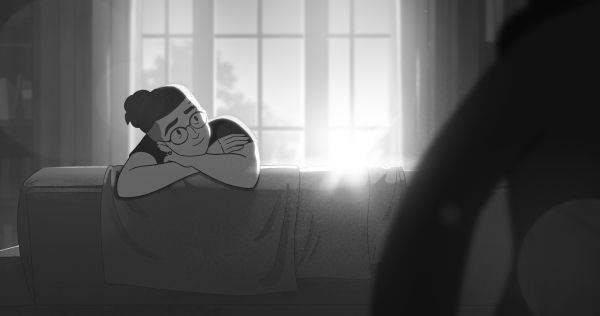
The first time we meet Sarah’s mom, Midge (voiced by Julia Louis-Dreyfus), she looks badass. After young Sarah wakes up from a nightmare, Midge comforts her by grabbing a flashlight and, in a rare moment of color in this black-and-white animated film, swings it around like a lightsaber to scare the monsters away. Years later, while passing by an LGBTQ rights protest, Midge openly calls out some boys yelling bigoted slurs without hesitation—a sign that, for all the problems Sarah found with her conservative Maine hometown, her mom always had her back.
Cut to 1999, and adult Sarah (Abbi Jacobson) is trying to leave her mark on the world, working as a receptionist and occasional artist for a queer San Francisco magazine. It’s Sarah’s big goal to design bold, provocative covers that address issues she cares about, second only to hooking up with the enigmatic, motorbike-riding lesbian of her dreams, Donimo (Samira Wiley). Yet returning home to Forestville proves difficult. Her once-chipper mom is now ill-tempered and inattentive, even leaving the iron on while gardening outside. Though Midge and her husband, Rob (Bryan Cranston), blame this on the stress of being fired from her teaching job, Sarah can tell that something’s clearly wrong with Midge’s mind.
Tangles, based on Sarah Leavitt’s 2010 graphic memoir, maintains its tragic autobiographical story while updating the visuals in line with similar animated films like 2007’s Persepolis. Told in black-and-white animation that blends realism with psychological surrealism, the movie explores the hardships of Alzheimer’s disease while grappling with one family’s struggle to accept this outcome and make the most of their relationships while there’s still time.
Though Sarah’s family completely accepts her sexuality, they’re severely in denial of Midge’s condition. At first, Sarah can’t seem to get her dad or sister Hannah (Beanie Feldstein) to take this matter seriously, with the family consulting a naturopath in place of actual medical advice. It’s only during a trip to Mexico—when Midge wanders off—that they finally agree to test her, leading to the heartbreaking Alzheimer’s revelation. Anyone who’s lost a family member to Alzheimer’s can attest to the pain of watching them forget everything, and Tangles doesn’t shy away from the toll it takes on this household. Each member grapples with Midge’s deterioration in their own way, with Sarah struggling to balance work and romance over time as she puts more and more effort into being her mother’s caretaker.
At its most raw, Tangles wears its pain on its sleeve—or, in this case, its graphics. Though it largely commits to semi-grounded storytelling, the movie occasionally branches into abstract or psychologically challenging visuals that reflect the headspaces of mother and daughter. The most frequent running joke involves a faceless flight attendant (Sugar Lyn Beard) delivering remarks on the PA system, each needling Sarah about her insecurities and fears between destinations. Other moments go for a more darkly comedic effect—such as Sarah playing in a casino where each game of chance teases the odds of Midge’s exact diagnosis—but the tragedy is ultimately inescapable. Good things play out alongside the bad, allowing Sarah’s family to give Midge some happy memories while she still has a chance to remember them.
This is an emotionally charged production with a solid lineup of A-listers, particularly Jacobson and Louis-Dreyfus. Cranston, another standout, plays Rob as a helpless man struggling to accept his wife’s condition as more than just a speed bump in their relationship. Not all voice work seems distributed evenly; in particular, Wanda Sykes and Seth Rogen are underutilized as Sarah’s boss and Hannah’s boyfriend-turned-fiancé. Even so, director Leah Nelson gives this production an intimate tone where, no matter how much this family frustrates you, their pain feels authentic.
One gets the sense that Tangles could have delved a little deeper with its exploration of Alzheimer’s. The bulk of Midge’s deterioration happens while Sarah is away from home, and while that produces a shift in her artistic output, the personal fallout takes a lot longer to witness up close. That core dynamic between mother and daughter—one holding onto memories of her mom’s best self and the other gradually forgetting everything—is where Tangles’ tragedy is on full display. Those memories stay with family, even after the disease takes its toll on the mind and body.








Leave A Comment