For the right readers, the stories of Polish writer Bruno Schulz are one of the great joys of world literature. They are difficult to describe and hard to do justice in a limited space. In a cycle of tales collected in a book less than 300 pages long, most of which are set in a town resembling his native Drohobych, Schulz created a world that is relentlessly wondrous, fertile, and treacherous. Here, the inanimate often seems or is animate; seasons, months, and time itself are described as though they are sentient; pots and pans will literally break free from attics and march into the sky; and the main character’s uncle turns into a doorbell. None of this needs to be explained—it’s just the way it is. Throughout the stories, one of the most moving and compelling figures is a tailor of vertiginous obsessions and delusions who dies and returns several times. The title of the final story, fittingly, is usually translated as “Father’s Last Escape.”
The Brothers Quay, the award-winning and groundbreaking duo behind experimental and feature-length animated films, have turned to Bruno Schulz before. Their 1986 short, The Street of Crocodiles, inspired by Schulz’s story of the same name, is not a literal adaptation but a marvelous evocation of and response to its themes. It is at once a beautiful homage to Schulz’s work and wonderfully its own thing. Their new film, Sanatorium Under the Hourglass, their first feature since 2005, is inspired by the motifs in his work writ large, including but not limited to the story from which it takes its name. Again, they have made a film that will confound those in search of normal narrative logic, yet it is beautifully attuned to its own unconscious rhythm. It is also, in some ways, more straightforward than some of their previous efforts and is very much in tune with said story, though it includes elements from elsewhere in Schulz’s work.
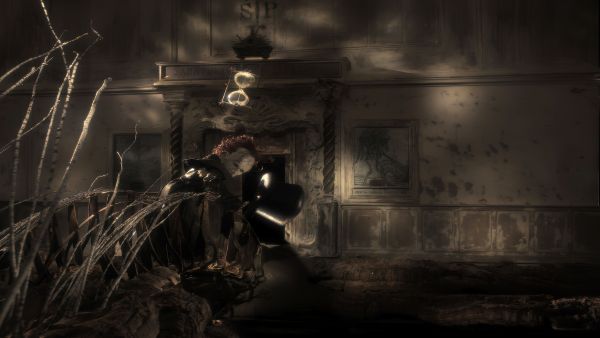
In Schulz’s story, a young man named Josef visits his father in a sanatorium beyond the bounds of normal existence. Josef, represented in the film by a wooden puppet, travels by train to a sanatorium where patients and inmates often fall asleep. Once he arrives, Josef wanders the dark, dingy corridors of the sanatorium; meets the doctor, also a puppet, who mysteriously has many arms; waits for his father, calls out to him, and perpetually falls asleep (there is a recurring motif of Josef slumping forward in his seat). The halls are usually empty, and no patient seems to be attended to. Mysterious activity appears to be taking place behind the doors. The doctor scuttles around, sometimes speaking cryptic statements and often caught up in his own business. He tells Josef that his father is dead to the world but alive in the sanatorium because they’ve turned back the clocks. They are operating just behind the timeline of the outer world “by an interval that is impossible to define.” Puppetry aside, this is all fairly close to Schulz’s story. Parts of the author’s text are even spoken.
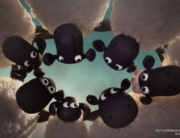
This is, however, just one thread of this film, and though it anchors everything else, it’s not even the first sequence we see. The film begins in darkness with a few flickers of black-and-white images (a woman’s face next to her knee) accompanied by an eerie, static-laden soundtrack. That sets the tone for the way images and figures seemingly emerge from a haze or a dark dream. Scenes on a sort of stage inhabited by puppets often occur when Josef falls asleep. The filmmakers also employ an arresting technique in which they take a square frame and then zoom out in sharp, aggressive cuts, making the image smaller and smaller.
Of course, many viewers will find it cryptic and pretentious. The film also has a special meaning to those who know and love Schulz’s work. Yet, I am convinced that the film still succeeds on its own strange terms even if you walk into it blind. Since the filmmakers have anchored the film with Josef’s journey to see his father in a sanatorium, and since this storyline is constantly interrupted by various visions, it conveys the sense of losing a loved one to the other side and of trying to visit them in a place barely understood.
I was expecting this film to be creepy and mind-bending, but I did not anticipate being as moved as I was to hear Josef’s voice calling for his father, echoing along empty halls. The Brothers Quay have found a wonderful and unlikely balance between abstraction and narrative. I approached it worried that, like so many directors with a unique aesthetic, they would allow their style to turn into a kind of kitsch. I finished the film convinced that they had pushed themselves boldly into beautiful new places. I think some viewers will agree.


Leave A Comment