
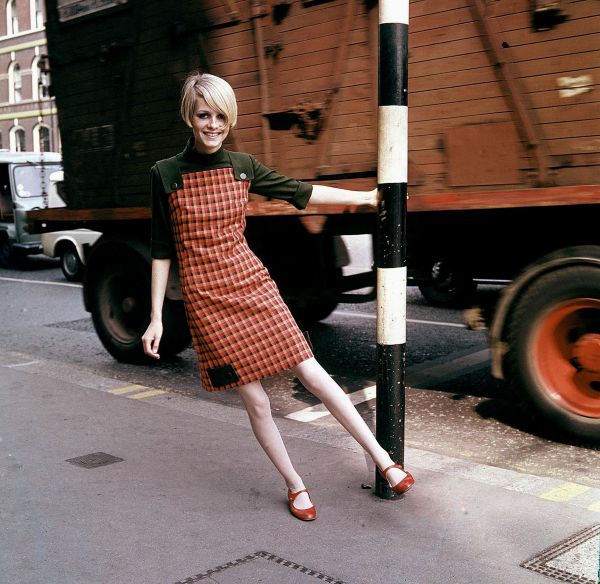
“What happened to me you couldn’t plan in a million years, really,” muses the former Lesley Hornby, now Dame Twiggy Lawson. And how. Sadie Frost’s bubbly documentary charts how a skinny, working-class Cockney teenager became the first top model in the UK, then blew up as the symbol of a worldwide youthquake, before finally transitioning to a fresh yet respectable showbiz career.
Twiggy has consorted with stardom’s biggest and best. Legendary fashion doyenne Diana Vreeland promoted Twiggy, and Frost calls on big boomer heavyweights like Paul McCartney to sing her praises. Twiggy herself remains low-key and down-to-earth, almost as bemused as we are by the ups and downs of her wild, decades-long career.
Twiggy’s emotional resilience emerges as a theme throughout. Lesley Hornby grew up in working-class London as the daughter of a supportive father and a mother who struggled with bipolar episodes. Her modest background may have helped prepare her for fame. Twiggy’s cohorts, the Beatles, knew how to offhandedly charm their way around hostile questioning; although less assertive, Hornby similarly shows a gift for ducking and feinting. The opening montage unspools clips of her striking poses as interviewers troll and bait her, but the model now known as Twiggy just laughs and shrugs them off. Her aplomb would likewise help her withstand romantic disappointment and even heartbreak, though fortunately not career slumps, which the movie—in one of its most interesting aspects—reveals never really befell Twiggy the way they did so many young stars. Although she is primarily known as a model, her showbiz path has led her to acclaim in film, theater, and TV.
Bestowed her one-word moniker after the earlier nickname Twigs, the young girl was a teenage Mod daydreaming about stardom when she took up with an older man of 25, Nigel Davies. Davies styled himself as the more glamorous Justin de Villeneuve and shrewdly pushed Twiggy as a spontaneous new face in London’s hidebound modeling scene. After a few false starts, Twiggy’s photo caught the attention of an editor at the tabloid Daily Express (“It’s all about the eyes,” she says as she sums up the picture). Soon Twiggy was The Face of ’66, capturing the era’s go-go energy with her angular, slouchy body and what old friend Joanna Lumley calls her “gender-fluid, little elfin face.” A dizzying array of shots set to nostalgic tunes shows off her ubiquity on The Tonight Show Starring Johnny Carson, The Sonny & Cher Show, and a parade of pop-culture venues. “I went from being a shy, introspective schoolgirl to being known all around the world, so it was a bit peculiar,” she matter-of-factly recalls.
She won two Golden Globes singing and coltishly dancing in Ken Russell’s The Boy Friend. She made a lifelong pal of Tommy Tune on Broadway in the Gershwins’ My One and Only, snagging a Tony nomination along the way. A concert with a full orchestra at the Royal Albert Hall showcased her skills as a singer. After a breather, she returned to fashion, where she was welcomed back by a new crop of celebrities like Sienna Miller and Kate Moss. People of all ages praise Twiggy’s laid-back attitude and lack of ego. The cozy vibe is a testament to British showbiz, which venerates its throwback stars and generously allows them to share the spotlight with younger celebrities.
All is not dim lights and rose petals in Twiggy’s story, however. Boyfriend/Svengali de Villeneuve turned out to be a right rotter who had to be sent packing, and Twiggy’s first husband, actor Michael Whitney, fell victim to alcoholism and met a tragic early death. With characteristic optimism, Twiggy has since moved on to a happy and lasting marriage and enjoys the company of her grown daughter. She’s still creating, seeing, and being seen. “I’m fortunate to do the things I love,” she reflects. Sometimes it’s wise to keep things light, a credo both the star and the film take to heart.



Leave A Comment