
Some films begin with such an energetic and exhilarating opening that it threatens to become the high point from which they never recover. Sometimes that introduction is simply the perfect appetizer because the best is yet to come. The latter is true of The Rivals of Amziah King, though even then you will want to return to that opening sequence by the time it ends.
At an outdoor fast-food spot, a local bluegrass band waits for their leader, the titular Amziah King (Matthew McConaughey). When he finally arrives in his truck, he takes a few seconds to place his usual order before getting ready to sing. And what a performance it is: music played with passion and speed, accompanied by guitars, banjos, and mandolins, as the food order is completed and, simultaneously, several police cars surround the place. The imagination runs wild: Is the singer a fugitive? Why is the band still playing if he is? The opening credits begin appearing onscreen while the visual grammar becomes increasingly elaborate through a series of jump cuts and freeze frames that punctuate details we don’t know whether to pay attention to or simply let wash over us. Five minutes in and you’re already locked in.
Written and directed by Andrew Patterson, this is his sophomore effort after the compelling sci-fi movie The Vast of Night (2019), criminally underrated and underseen to this day (a “streaming movie” lost in the Amazon Prime catalogue). The Rivals of Amziah King is another original screenplay of his that could not be more different in essence or setting: a thick Southern spell cast over the backwoods of Oklahoma, with a story that could easily be the stuff of a folk song or a great American novel. Considering its extravagant title, one would probably have some bored, sensible producer imagining all the marketing difficulties and rejecting it as too confusing to sell. You might have to check twice that it isn’t based on a book; it radiates the spirit of a literary classic resting on a shelf somewhere between Mark Twain and Herman Melville.
Amziah King is a local beekeeper, the owner and master of his small honey-production business, which he runs almost entirely on his own. He loves the bees, the job, and above all, his community. And his community loves him back, which explains why the local police force turns to him for help solving the mystery of who owned the gallons of honey that have been stolen and recovered.
This alliance with the police sets the central mystery in motion: the apparent existence of a criminal network stealing and trafficking honey from local producers, a potential threat to Amziah that anticipates what could easily become the material for a full-blown crime thriller or action movie. Although it eventually takes on those trappings, this unpredictable movie contains multitudes of genres and swaps them at will, with a sense of style and a fascination for the possibilities of cinema when it isn’t chained to the labels and tropes of being and behaving like only one genre.
In fact, part of the film is semi-episodic, structured around self-contained scenes in which a few doses of expository dialogue, committed performances, and rhythmic editing quickly make you care about a myriad of supporting or tangential players. An early highlight finds Amziah and his crew helping an elementary school overrun by a swarm of bees. Later, another sequence depicts different anecdotes about each person who has brought a dish to a potluck. These moments build a mosaic of a small human universe that feels palpable and real, like lives that continue to exist and unfold beyond whatever the camera happens to be focusing on.
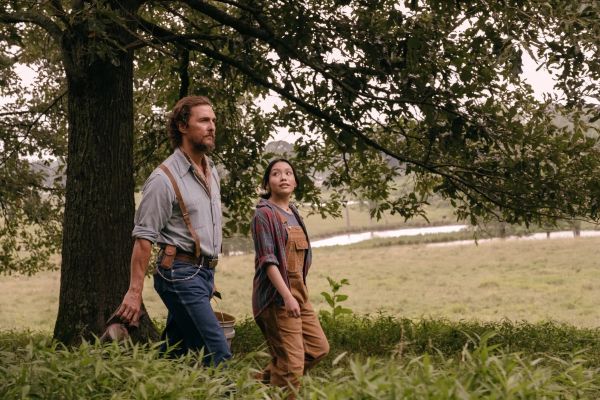
One central relationship is the tender father-daughter, mentor-pupil dynamic between Amziah and Kateri (Angelina LookingGlass), a former foster kid whom he and his wife had cared for and with whom he reconnects as a young adult, now free from the foster-care system. At this moment, he is a widower without children—or heirs. Clearly, there is a succession drama here, in which one generation prepares the next to be better and to preserve a way of life, a particular vision of how to conduct oneself, and a place within the community—and of how that community comes together to help and sustain one another when necessary.
LookingGlass proves to be a discovery, capable of holding a candle alongside the star whenever she is asked to carry the film on her shoulders. For his part, this represents a welcome return for McConaughey. Watching him allow an entire arm to be covered in bees without flinching creates an iconic image, but it also reminds us how daring and liberated an actor he can be after years of absence.
However, because of its mutable and even playful nature, Patterson’s film is committed to misleading the audience as much as enchanting it nonstop, which can make or break it between its two distinct halves. Let’s say there is a kind of twist—or rather, a transition—that changes the focus and destination we thought we were heading toward from the second half onward.
Prepare yourself to sing (or to tap your feet) and to cry: The Rivals of Amziah King is a secret banger. At times a western built around indirect duels (the “rivals” in the title have a reason to be there), at others an immersive musical (there are at least six musical performances interconnecting ideas and actions throughout), it eventually incorporates elements of a heist and revenge thriller. Additionally, only a charismatic actor like McConaughey could deliver intense philosophical lessons in beekeeping. There may not be a better cinematic treat in August than this.


Leave A Comment