For a certain group, Kane Parsons—the mind behind Backrooms—is a talent they have followed for years, now making an adaptation (through expansion and reinvention) of the viral web series he created when he was 16. For everyone else, the far more surprising aspect will be the idea of a 19-year-old debuting as a director with a film produced by A24 and validated by A-list Hollywood talent (James Wan, Osgood Perkins, and Shawn Levy as producers, alongside a pair of Academy Award–nominated actors in the lead roles).
The concept behind Backrooms is tied to its origins as a creepypasta born from a mysterious image uploaded to the internet and the collective work of online users feeding a shared mythology for the sake of fun. This, in turn, evolved into the idea of liminal spaces: in-between places that may be physical (hotel hallways, abandoned offices, or buildings under renovation) or existential. One could say it is a symbolic representation of the labyrinths of the unconscious, but also of the anxiety produced by isolation and loneliness. Parsons draws upon these ideas—both borrowed and newly reshaped—to create a universe that feels authentic and fresh.
Set in the suburbs of Silicon Valley sometime during the 1990s, Backrooms immediately establishes a vision anchored in the analog: a pre-smartphone era of camcorders, evenings spent in front of the television, and endless commercials in which ordinary people could promote their local businesses. It is not exactly a faithful representation, but rather a memory deliberately distorted by nostalgia for a simpler and more innocent era. Here, Clark (Chiwetel Ejiofor) and Mary (Renate Reinsve) are confined to lives in which nothing seems to exist beyond their jobs and their memories. In their private moments, they sit silently in homes with no families, accompanied only by the television.
Mary is a therapist treating Clark. During one therapy session, he divulges that he lost his marriage due to his drinking habit and his obsession with working late at the furniture store he owns. An architect who never managed to practice his profession, he now lives and works full-time in a warehouse with no customers and mounting debts (he literally sleeps at night in a bedroom set he sells). His only human contact comes through his assistant manager, Kat (Lukita Maxwell), and her boyfriend, Bobby (Finn Bennett), who is obsessed with filming everything on his Handycam. Despite her professional pose, Mary has no better life. She is constantly ruminating over her difficult childhood under the troubling guidance of a mentally ill mother, although in her television commercials, she promotes a self-help book promising readers “a window within” toward a better life.
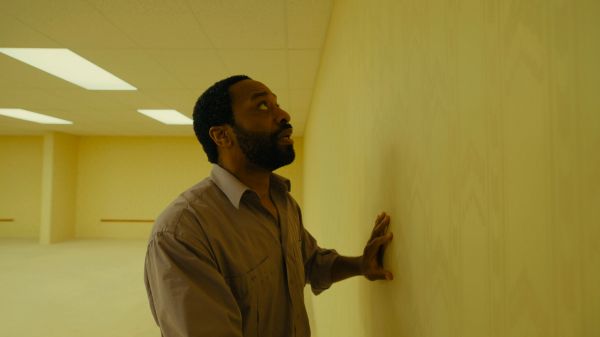
While trying to fix the constant power problems in the store, Clark discovers a secret portal in the basement, and curiosity outweighs fear as he decides to explore what turns out to be a succession of rooms leading endlessly into more rooms with slight and progressive variations (ad infinitum?). In these “backrooms,” the walls are yellow, the floors carpeted, and the spaces often completely empty, though sometimes cluttered with piles of chairs, cabinets, or clothes, or posters. The further he advances, the stranger the rooms become, until doors give way to tunnels, passageways, and architectural peculiarities that make no sense in terms of scale.
Clark convinces his employees to follow him deeper into the maze and document their discoveries, but the consequences are unfortunate. As they advance, it becomes clear the visitors are not as alone as they believed. Abrupt noises and fleeting shadows passing by reveal that this labyrinth shelters monsters of its own. Yet Clark seems strangely comfortable there and eventually disappears completely, prompting Mary to go searching for him. (During an earlier session, Clark had spoken to her about this place, though at the time she did not believe him.)
Does the place mutate according to the nature of its visitor? Are the monsters reflections of the ones each person carries inside? With a screenplay by Will Soodik that remains faithful to the spirit of Parsons’s original conception, the film wisely avoids too much exposition. Thanks to that restraint, it builds an unsettling atmosphere governed by a kind of dream logic without falling entirely into abstraction. Very rarely does what we casually call “Lynchian” outside the work of filmmaker David Lynch actually deserve the label, but here there are moments that genuinely feel so, especially recalling the late Lynch of Inland Empire and Twin Peaks: The Return. There is one particular scene involving the sudden appearance of distorted human figures where the spirit of the late filmmaker seems to have found a young heir.
For a little over an hour, Backrooms is a hypnotic experience that keeps us on the edge of our seats. By the third act, there are perhaps a few decisions that feel questionable; they lean less toward preserving mystery and more toward easy scares and capping things off, though not severely enough to derail the film. In any case, the movie preserves its essence because it feels driven primarily by instinctive rather than intellectual decisions.
Because of the overwhelming visual and sensory labyrinth, Backrooms is a fortunate marriage of an attractive concept and compelling execution, while featuring one of the year’s most remarkable achievements in production design. It could only have existed in a post-pandemic world, shaped by years of oversaturation and information overload through our dependent relationship with the digital sphere. Its metaphysical narrative—which may very well end up becoming the best horror film of the year—draws from something primordial while also remaining inevitably tied to today, highlighting the need for an exorcism capable of restoring something lost.






Leave A Comment