
Frank Sinatra and Elvis Presley were pioneers, but the monocultural supremacy of the Beatles led to the ultimate example: a pop star as an inescapable phenomenon existing in a particular moment in time, someone “bigger than Jesus,” in the words of John Lennon. Later, Madonna, Michael Jackson, and Prince (among others) mastered the mystique and expectations that a pop star must also be a multimedia, multifaceted artist in constant reinvention. So, it is refreshing when a movie like Mother Mary appears, because it gets it right without pop-phobic notions.
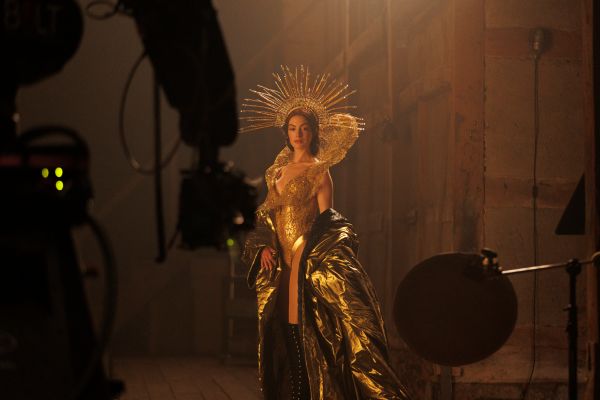
David Lowery’s new movie is, in many ways, unclassifiable, flirting with different genres and featuring a mise-en-scène both restrained and grandiose at once. A seasoned pop star known as Mother Mary (Anne Hathaway) has spent several years away from the spotlight following an accident that impacted her spine and forced her into a sort of isolated self-retirement. (She fell from a floating stage and was left hanging in the harness that held her.) In an opening sequence set in the past, the film introduces her at the height of her powers, dancing and singing before a stadium filled with devoted fans. This image immediately evokes Taylor Swift’s Eras Tour, but her stage name, the aesthetic paraphernalia borrowed from Catholicism (she always wears a halo), and the maximalist dance-pop (original compositions for the film) scream more directly Madonna and Lady Gaga.
Mother Mary is ready for her comeback with the performance of a new song at an awards ceremony. However, as she tries on the outfit intended for the event, something isn’t right. She is overcome by a sense of unease, something that has been haunting her since before the accident. She believes it can only be resolved by reconnecting with a former collaborator. Sam Anselm (Michaela Coel) is a fashion designer, but before achieving the stability and tranquility of working and residing in an English country manor, she used to design the pop star’s costumes. The two fell apart—Sam was no longer needed, trust was betrayed—and she managed to start over and, perhaps for the better, made a name of her own. So, when Mother Mary appears at her door asking her to design the dress for her comeback, the situation is hardly conducive to an instant reconciliation, especially given the pressing timeframe to complete the task (three days).
Lowery, who also wrote the script, opens a narrow window for the audience to look in and discover just enough. He tells a story of a breakup, its effects, and the possibilities of reconnection between two people who were not lovers, family, or even friends, but whose deep connection remains vital even after it has been fractured—two souls linked by art and a common purpose. The designer ultimately accepts the job under certain conditions: Mother Mary must accept the final result and raise no objections to the methods necessary to achieve it. The pop star only asks that the dress must not be red. This warning will undoubtedly matter later.
Although the film is essentially a two-hander filled with conversations and a few monologues, it never feels exclusively theatrical or lacking in cinematic imagination. The editing interweaves musical performances, flashbacks, and a ghost story shared by both women involving a figure made of red fabric. A dance performed without music (because Sam refuses to break her streak of not listening to Mother Mary’s songs) and the recounting of a séance are among the sequences that highlight genres like the musical and horror to create an entrancing experience. However, the film draws from much more primordial and classical sources in shaping what ultimately becomes a melodrama of artists, evoking the spirit of highly sophisticated movies in which the dialogue becomes the most vital thing on screen.
Hathaway is breathtakingly beautiful and vulnerable, alternating between scenes where she is a fierce pop star and then the insecure woman afraid of not being able to perform—the only thing she knows how to do. This is one of her best performances in a year in which we will see much of her on the big screen. Coel, for her part, will be a revelation for those unfamiliar with her work, with body language and a delivery of lines capable of making anyone tremble. A weak link here are the songs composed by Charli XCX, Jack Antonoff, and FKA twigs (who makes a brief but substantial appearance). They are engaging and functional but do not suggest the kind of timeless hits that have made Mother Mary an essential artist.
Mother Mary explores the spiritually and emotionally rich inner world of a pop star, and the nerve and risk of giving oneself to the world on a massive scale. The film captures this through a unique kind of ghost story, which serves as a reminder of Lowery’s remarkable talent for building self-contained stories and characters that feel mythical and foundational, as if they had always been there waiting to be told; the result could very well become a cult classic. It works and sounds like well-crafted pop: accessible and seductive, as well as unpredictable and strange.



Leave A Comment