

Ghosts of the past haunt the documentary-style drama Blue Heron—ghosts of thoughts unspoken, ghosts of a family tragedy, and ghosts of what might have been. The powerful first part of Sophy Romvari’s semi-autobiographical story reveals a frightening family struggle (and the myriad problems it causes) through the eyes of a young girl, smartly depicting her overlapping childish confusion and gradual understanding. It’s this impressionistic, enigmatic tone that makes the work special and intriguing—like the youngster at the movie’s center, viewers grope to get a grip on something hard to fathom but scarily real.
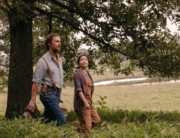
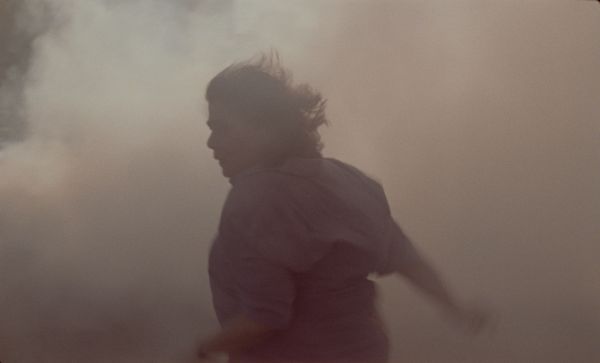
The film introduces a freewheeling family with four kids. A Hungarian immigrant couple (Iringo Reti and Adam Tompa) have settled their brood on rural 1990s Vancouver Island in a ramshackle house surrounded by nature. Handheld camerawork follows eight-year-old Sasha (Eylul Guven) and the other children at play and mischief, while microphones pick up their offhand comments and the ambient noise of simply living.
It takes a while to grasp that something is wrong in this slice-of-life scenario. The woman’s son and the man’s stepson Jeremy (Edik Beddoes), a blond, bespectacled teenager, does not respond to the rhythms of life in the house. He pretends to be dead at one point, sprawled on the stairs out front. On another occasion, he incessantly pounds a basketball against a wall. In tense conversations, the parents argue over how to reach the boy. When the son is brought to the house handcuffed in police custody, we know Jeremy’s issues go beyond teen fooling around.
Expressionless and mostly shot in the middle distance, Jeremy remains something of an unknown. The way we learn about him is how we often find out about our own troubled family members—through hearsay. The mother discreetly tells her daughter to keep quiet about the boy’s behavior and refrain from inviting friends over to the family home. Jeremy and Sasha’s parents seem like decent, loving people, but their marriage is clearly under strain. An officious doctor recorded on tape lectures the mother while offering an unhelpful diagnosis, and social workers propose a solution that baffles and offends the family. Without conventional dramatic gestures propping up the narrative, we sense darkness ahead.
True to a somewhat withholding style, the film does not let us witness what happens to Jeremy. The narrative devotes itself to finding the origins of this emptiness and, in a quest for truth, starts to experiment with timelines that trace how the young man left the family. Actress Amy Zimmer steps in playing a young adult version of Sasha, a filmmaker. She questions a symposium of real-life social workers about how her brother could have been helped; the ensuing dialogue feels earnest, well-meaning, and slightly out of place, although it does serve the purpose of exposing the depth of Jeremy’s delusions. The film also poses the grown-up Sasha as a social worker going back in time to confront her parents. These developments can be initially confusing. Still, the ache of memory persists.
Blue Heron leaves a bereft sensation and an absence at its heart—the loss of a young man and everything his family lost with him. Nothing remains but questions that no one can answer, perhaps the most haunting questions of all.
Leave A Comment