Why did Sara Jane Moore, a 45-year-old mother of four, try to assassinate President Gerald Ford in San Francisco on September 22, 1975? Robinson Devor’s compelling portrait doesn’t really answer that question because his subject is so contradictory and self-serving in what she shares with the director.
When Moore was released from prison in 2007, Devor filmed a series of extensive interviews with her, with one stipulation: She would be the only one interviewed for his documentary. (Moore died this past September, at age 95.) This allowed the filmmaker to shape his profile to match his narrator’s often unreliable recollections.
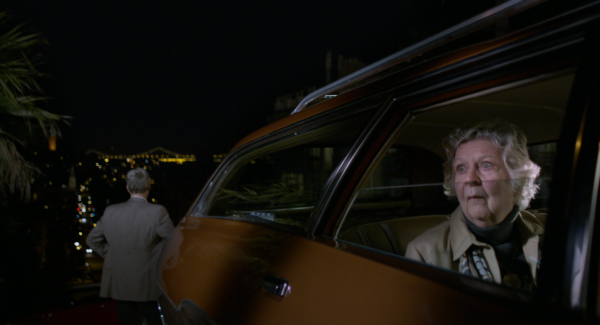
As Moore answers questions about her life and what led to her targeting Ford, Devor films her in actual San Francisco locations, including the hotel room where Secret Service agents took her after the assassination attempt. She also tells all while sitting in the back seat of a station wagon as Secret Service agents can be seen lurking in the background—a quietly ominous reference to the events of a half-century ago. These sometimes revealing, often combative interviews are intercut with an array of archival footage that touches upon her story.
There are headshots and glamor shots of a young Moore as she describes joining the Actor’s Studio, taught by Lee Strasberg, and recounts the disappointments in her personal life, including five divorces. TV news footage of volatile 1960s and ’70s events—the Vietnam War, the kidnapping of millionaire heiress Patricia Hearst, the Watergate scandal and the subsequent resignation by President Nixon and Ford becoming president in August 1974—gives important context to the question of how a white conservative suburban housewife became radicalized and fired two bullets from her .38-caliber handgun at the president (this happened only 17 days after another woman, Lynette “Squeaky” Fromme, shot at Ford in Sacramento).
Moore’s unreliability includes her insistence that a famous (but unnamed) musician was supposed to shoot the president, but she convinced him that he was too important for such an assignment and that she would take his place. She also got involved with the Black Panthers and Symbionese Liberation Army (SLA) (whose members came to include kidnapped and radicalized Hearst), even as she was friendly with Patty Hearst’s parents. (She says she knew her father and contacted him after the kidnapping, as well as worked in the food pantry provided by Hearst that was part of the SLA’s ransom demand.)
Moore admits she became extremely close to Popeye Jackson, an SLA sympathizer and Black radical, who was an influence on her evolving views from conservative to radical, but she refuses to take any responsibility for his death (he and another woman were killed, execution-style, in a still-unsolved case), which occurred while she was an FBI informant.
Yes, you read that right. She was recruited as an informant by the FBI’s Bertram Worthington, whose actual identity remains a secret. (The bureau refused Devor’s Freedom of Information Act request for information.) What we hear as his dialogue—spoken by Devor himself in intentionally overripe voice-over—is simply what Moore says she remembers of their conversations.
In an archival segment, CBS news anchor Walter Cronkite reports that Moore insists she never wanted to kill someone, but felt “the only way you can make a statement is to pick up a gun.” Decades later, she tells Devor that Ford and his vice president Nelson Rockefeller—neither of whom were elected but appointed because of Nixon’s resignation—were a “phony cabal,” to justify her extremist action. In its exploration of radicalization, conspiracies, and political violence, Suburban Fury is an audacious and thoughtful study of an uniquely American phenomena that are never far from rearing their heads again.



Leave A Comment