A year after its premiere, does Megalopolis still spark conversation? For the few who, like me, consider it one of last year’s best films, the answer is a resounding “yes.” Those who saw it and found it a misfire—a baroque fantasy from a madman filmmaker—are likely less interested in revisiting the discussion. However, Mike Figgis, a banner name of independent film, takes on that task with Megadoc, a companion piece and a self-critical work of its own that entertains the possibility of two contradictory truths: Francis Ford Coppola created a brilliant, visionary film, and that it was flop destined to become a cautionary tale.
The film’s utopian, anachronistic mix of sci-fi and pagan epic, inspired by ancient Rome, was compelling enough to attract a stellar cast. It also drew on the residual respect for the man behind such classics as “The Godfather” trilogy, The Conversation, and Apocalypse Now. Coppola, a director with a history of risking it all—bankrupting a studio, squandering fortunes, and taking on work-for-hire jobs to fund personal projects—had nothing left to prove and little left to lose. In his eighties, he made one of his riskiest decisions yet, gambling his winery fortune to realize the quixotic dream of a movie no one else would finance.
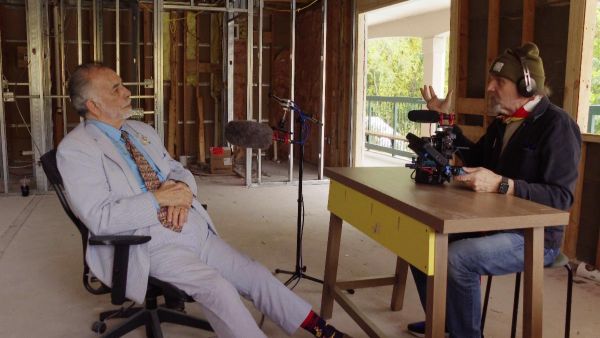
Megadoc wisely begins with unfiltered curiosity, taking full advantage of the access Coppola granted Figgis. Figgis, who understands the challenges of working both inside and outside the industry, isn’t simply creating a glorified featurette. Instead, he observes another artist with detachment and fascination, chronicling a creative process plagued by contradictions. In one interview, Figgis suggests that Coppola thrives in chaos, a claim the cane-in-hand, patriarchal director promptly refutes.
The unspoken tension between the two is rooted in film history, particularly Coppola’s work on Apocalypse Now (1979) and the documentary Hearts of Darkness: A Filmmaker’s Apocalypse (1991), directed by his late wife, Eleanor Coppola. While the filmmaker is determined not to repeat the Apocalypse Now saga, Figgis appears to be hoping for another Hearts of Darkness. The making of Megalopolis is no blissful affair, though it falls short of a total nightmare.
Despite repeatedly insisting that he just wants to have fun and make something beautiful, Coppola’s high-stakes gamble reveals a less carefree façade. Disagreements with the visual effects and production design teams highlight creative differences that ultimately led to departures. While it’s easy to sympathize with those who left due to Coppola’s lack of clear communication, the result, a stunning mix of practical and digital effects, proves he wasn’t stumbling in the dark visually.
The cast, featuring Adam Driver, Nathalie Emmanuel, Dustin Hoffman, Laurence Fishburne, Giancarlo Esposito, Shia LaBeouf, Aubrey Plaza, and Jon Voight, is remarkable. Driver’s presence in the documentary is minimal, likely due to a controlled interview arranged by his PR team. Other actors seem less fazed by the extra camera. LaBeouf, in particular, comes across as the most candid and vulnerable, grappling with his “canceled artist” label while clashing with Coppola in tense, though never crossing a line, interactions.
As a bonus, Megadoc includes footage from early table reads, camera tests, and shoots from the project’s initial 2001 pre-production. We see Robert De Niro and Uma Thurman involved in 2001, and Ryan Gosling playing what would become LaBeouf’s role in 2003. This archival footage is revealing—the final 2024 film wasn’t so different visually or narratively from its origins. Coppola’s process is less casual and improvisational than he suggests, a point underscored by his self-deprecating claim of being a “first-rate second-rate director.”
For those who either loved Megalopolis or simply love cinema (ideally both, though let’s not get too optimistic), an up-close-and-personal documentary about its creation is alluring. The pre-shoot workshops, where Coppola trains his cast like a theater troupe, are where Figgis best captures the infectious energy of artists. During the ongoing production, Coppola declares that cinema is the only art that kills what it tries to preserve. By following pre-production planning and avoiding anything that cost extra time and money, there’s not much room for what’s playful and spontaneous. Seen through the lens of Megadoc, Megalopolis confirms and denies this axiom, reminding us that savoring the creative process can be its own reward.





Leave A Comment