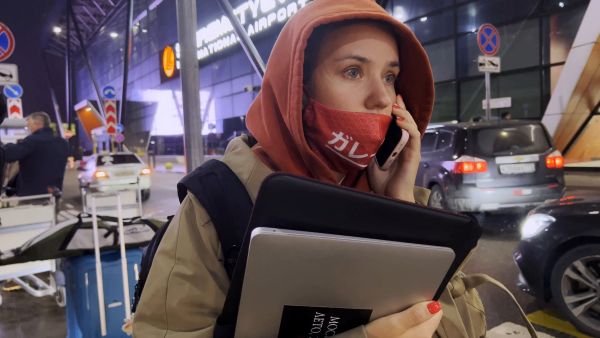
How does political persecution shape a person’s daily life in a place where black is no longer black and white is no longer white? In Russia, many journalists are restricted by being labeled “foreign agents,” if they haven’t already fled due to the war in Ukraine. As defined by the independent news outlet Novaya Gazeta, a foreign agent is someone receiving funding from outside the country. In practice, the Russian government uses the term interchangeably with “spy” or “enemy of the state.” Introduced in 2012 after mass protests against Vladimir Putin’s third presidential term, the law initially targeted institutions but gradually expanded to private citizens and media outlets.
Julia Loktev opens the documentary with her own voice, setting a bittersweet tone that lingers even in moments of celebration: “The world you’re about to see no longer exists. None of us knew what was about to happen.” She captures a wide swath of Moscow’s independent media scene, centered on the now-exiled TV Rain, shortly before Russia’s invasion of Ukraine in fall 2021. The film then cuts to excerpts from Who’s Got the Power?, a TV show hosted by journalist Anna (Anya) Nemzer, one of the main subjects and co-director. Nemzer’s program covers topics ranging from the plight of foreign agents to LGBTQ+ rights, domestic and state violence, migration, mental health, and homelessness. The brisk, fast-cut montage encapsulates the spirit of the film, especially a guest’s hope for “a democratic Russia.” (The idea of an impending war is a lingering ghost, with each journalist having a dark premonition about the future.)
Through Anya, the film unfolds as a novelistic portrait of opposition journalism in its final days. We meet Ksenia (Ksyusha) Mironova, a 23-year-old reporter at TV Rain; Novaya Gazeta long-form journalist Elena (Lena) Kostyuchenko; Sonya Groysman and Olga Churakova, early recipients of the foreign agent label who later launched the podcast Hello, You’re a Foreign Agent; and best friends Alesya Marokhovskaya and Irina (Ira) Dolinina, also among the first so designated.
Many scenes take place in Anya’s living room, a hub of camaraderie and solidarity for journalists, activists, and friends. Shot on Loktev’s iPhone, the film feels casual and intimate. It unfurls with a casual intimacy that makes the audience feel at home. Though she stays off-camera, Loktev’s presence surfaces through the occasional wry remark or question.
Anya describes the shutdown of Memorial, the human rights organization founded at the fall of the Soviet Union to document the regime’s abuses. Its closure is symbolic: the erasure of alternative narratives, paving the way for Russia’s invasion of Ukraine. The film asks: When does oppression tip into full-blown Stalinist authoritarianism—targeting not just individuals but collective memory itself? It also reminds us that war rarely occurs overnight; it is built on propaganda to manipulate public consent while silencing the past.
The first half (chapters 1–3) ends with the sound of footsteps—the Russian invasion of Ukraine in February 2022—and the first week of war. These chapters establish a vivid sense of what it means to be a journalist in a country ruled by propaganda. Over more than three hours, Loktev takes an unorthodox, episodic approach, allowing events to unfold organically and giving each subject space to breathe. The structure builds parasocial bonds with the journalists, as if we were watching a serialized drama with cliffhangers.
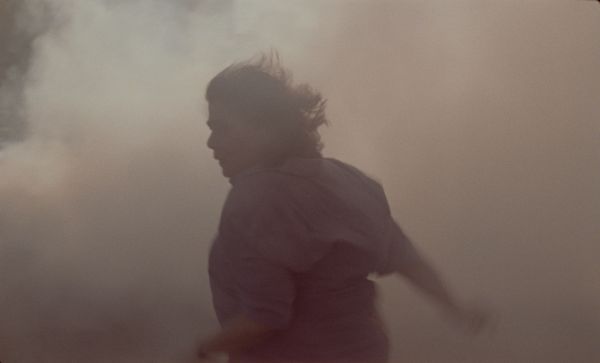
The second half, chapters 4 and 5, focuses on the first week of Russia’s invasion of Ukraine, seen through Loktev’s eyes as she follows several soon-to-be exiled opposition journalists. The tonal shift from the first three chapters is striking. Gone is the nervous but resilient camaraderie. Nemzer mourns, “I don’t have a country anymore,” before fleeing with her family on what was meant to be a one-week trip. Mironova wrestles with whether to leave to avoid persecution or stay in Russia with her fiancé, journalist Ivan Safronov, held without trial as a political prisoner.
The certainty that things will only worsen propels them into action: They scramble for visas and safe passage to avoid imprisonment for their reporting. With mordant humor, Mironova jokingly likens Russia’s looming catastrophe to Harry Potter, noting that even opposition leader Alexei Navalny referenced the series at his trial. Like Harry, Ron, and Hermione, they must escape a collapsing ministry and outwit a bald-headed villain.
Though the gallows humor and pop-culture asides remain, the second half morphs into a tense thriller as the journalists face one obstacle after another: securing vaccination papers for a dog, finding a country whose borders remain open, skirting constantly shifting laws to avoid arrest. Loktev edits these moments with the tautness of an espionage film, revealing how completely war and political persecution consume her subjects’ lives.
My Undesirable Friends: Part 1 – Last Air in Moscow is both a masterful portrait of life under authoritarianism and a vital contribution to preserving collective memory.


Leave A Comment