
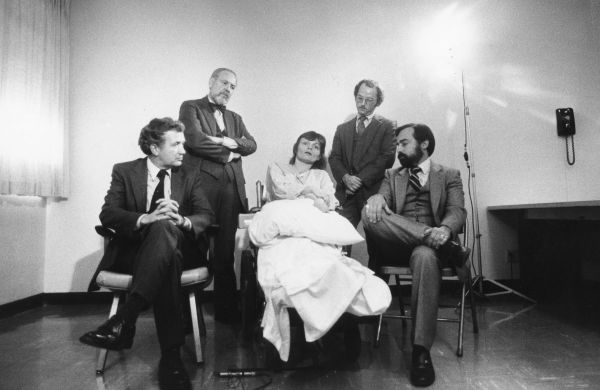
Not many may remember Elizabeth Bouvia, but her demand for the right to die—because she had cerebral palsy and severe arthritis that left her almost completely paralyzed—is at the center of Reid Davenport’s angry, unapologetically polemical documentary.
In his sophomore effort, Davenport (I Didn’t See You There)—who also has cerebral palsy and uses a wheelchair—tackles a subject close to his heart and one he knows is polarizing: assisted dying. He frames the issue through the lens of disability rights. Although he references several related cases, he keeps returning to Bouvia, whose legal battle culminated in 1983, when a judge ruled that her right to die did not outweigh the state’s interest in keeping her alive.
Davenport and his producer, Colleen Cassingham, investigate Elizabeth’s case and track down her two sisters, Rebecca and Teresa—the latter providing valuable insight into Elizabeth’s traumatic life. (Elizabeth died in 2014. Before Teresa informed him of her death, Davenport found an online photo of a smiling woman in a wheelchair dated 2018—obviously fake. Because she looked so happy, he had desperately wanted it to be her.) After her court loss, Elizabeth returned to the public eye more than a decade later when Mike Wallace profiled her on 60 Minutes. Wallace appears sympathetic, though slightly condescending, as he—an able-bodied man—clearly struggles to understand why she wouldn’t want to live. That Elizabeth later said she did want to live, despite the great pain she endured (including being force-fed through tubes), doesn’t change Davenport’s perspective.
In 2016, Canadian lawmakers passed a bill allowing medical assistance in dying (MAID) for eligible adults. Soon after, the number of Canadians choosing MAID skyrocketed, even surpassing rates in Scandinavian countries that had allowed the practice for much longer. One person who considered MAID was Michal Kaliszan, who shares how, after his mother, also his caregiver, died, Ontario’s provincial government approved only 11 hours of assistance per week, far short of the 24 he needed. The alternative: placement in a long-term care facility, where, he says, he would have had no quality of life and would have died quickly.
Melissa Hickson, from Austin, Texas, recounts how her husband, Michael—who became disabled after a cardiac episode led to a severe brain injury—was sent to a nursing home at the start of the pandemic. He contracted Covid and was placed on a ventilator. Doctors told Melissa that his quality of life was permanently diminished and that it would be more merciful to let him die. She vehemently disagreed, but to no avail. Melissa says she didn’t even learn of Michael’s death until the following day.
Stories like these are horrific, and they complicate Davenport’s narrative. After all, as awful as the Hickson case is, it doesn’t quite fit with the other right-to-die cases he presents. But Davenport acknowledges this. Fully aware that he’s addressing a thorny, possibly unresolvable issue, he derisively notes that some viewers may consider his film too “cynical.” Yet the result feels less cynical than deeply skeptical. As he says himself, Life After is “about the phenomenon of people desperate to find their place in a world that perpetually rejects them.”





Leave A Comment