
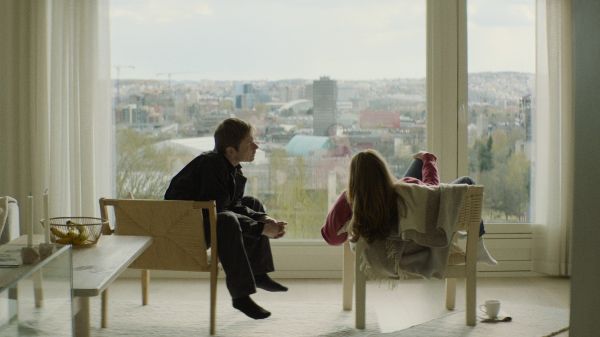
Does confessing always imply guilt? Or does a story—or an anecdote—become a confession depending on who’s listening and how they react? That question launches the layered, increasingly complex emotional threads of Sex, one of three entries in Norwegian director Dag Johan Haugerud’s thematic anthology “Love, Sex and Dreams.”
Two chimney sweepers—neither named in the credits—swap personal stories, unaware of just how intimate their disclosures are. The first, played by Thorbjorn Harr, is filmed in close-up as he recounts a dream in which he encounters David Bowie and walks away with an unsettling, lingering sensation. In the dream he feels seen—as though he were a woman. When the camera finally pulls back, we discover that his interlocutor—played by Jan Gunnar Roise—isn’t a therapist, as the scene initially suggests, but a coworker sharing a break. The friend hears a sexual undercurrent in the dream, one the first man insists isn’t the point. What follows is a meditation on how elastic desire can be and how it may surface spontaneously, whatever one’s declared orientation. At this turn, Roise’s character steps into the spotlight: The previous day, he confides, he slept with a male client right after finishing a job. Both coworkers are married with children, leading openly heterosexual lives that—until now—have gone unquestioned. And doesn’t mince details: He was the bottom.
To his friend, the incident could read as a professional violation, a personal betrayal (he did cheat on his wife, after all), and a disruption of their presumed sexual identities. The dreamer, an avowed Christian (refreshingly not homophobic), struggles to absorb the news, all the more because his coworker claims there is no reason for guilt or shame. He even told his wife. In his mind it wasn’t a big deal: He isn’t gay, cheating means forming an emotional bond, not merely having sex, and although the experience was satisfying, he has no intention of repeating it.
The rest of the film tracks the men as they grapple with the reverberations of the dream and the confession. Gradually, the second man begins to grasp that what he did is neither simple nor carefree as he claimed. His wife (Siri Forberg), also unnamed, is shaken to the core. She circles the incident again and again, unable to decide whether—or how—to forgive him. Haugerud handles it all with nuance and honesty, steering clear of pat conclusions about sexuality or relationships.
In Love, the anthology’s first installment, Haugerud populated his story with characters whose experiences of sex, friendship, and intimacy unfolded through long, revealing conversations. Sex is even talkier, yet the director’s interest isn’t limited to naturalistic chatter spiced with poetic or philosophical flourishes, even when the dialogue is eloquent and engaging. He plays with visual distance and proximity: We may hear one voice while watching another’s face, or see a speaker turned away, inviting us to anticipate an emotional response. (The wife, for example, is introduced with her back to the camera as she vents her frustration.) As in the earlier film—and, one hopes, in the forthcoming Dreams, winner of Berlin’s Golden Bear—Haugerud weaves together character study and intellectual inquiry in ways that spark reflection and post-screening debate.
Though Sex isn’t exactly a film about queer representation (Love and, by all accounts, Dreams delve further there), it offers a thoughtful look at heterosexual lives and masculinity. At one point a character crystallizes a key idea: “Homosexuality isn’t just an identity; it’s also an activity.” A single act may not make someone gay, but the reflex to distance oneself from the label, to insist that only self-identification counts, can be corrosive—it becomes a subtle form of shame, even in ostensibly progressive societies. Haugerud offers no easy answers, but sharp, relevant questions.
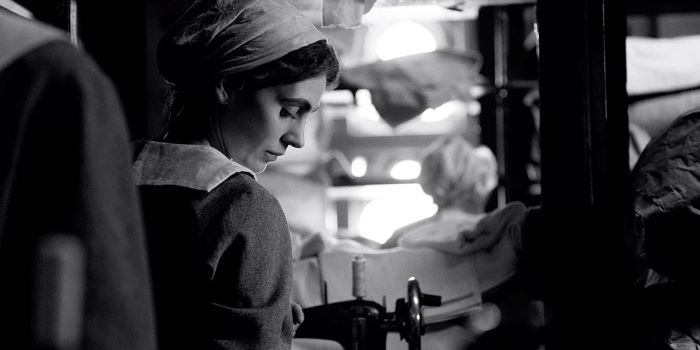
Two hours of conversation and one marriage circling a single confession might sound wearying, yet Haugerud’s willingness to pursue unexpected visual detours and sensual storytelling choices keeps the film lively. In one vignette, a doctor recounts how a gay couple’s relationship nearly imploded over a regrettable tattoo. The anecdote plays like a dreamy black-and-white short within the film. Another standout scene lets a church choir performance erupt into an ecstatic theatrical spectacle—flecked with queerness and a glimmer of Bowie that, until then, seemed incidental.
With two films released and a third poised to reach U.S. screens, “Love, Sex and Dreams” is shaping up as this summer’s most sophisticated cinephile secret—and as a set of modern, inviting postcards from vibrant Oslo.









Leave A Comment