
After numerous ventures into horror across film and television—many of them based on Stephen King novels—Mike Flanagan delivers his finest work yet as a director with the drama The Life of Chuck. The source material is also based on a King novella, though one not rooted in horror. It joins the ranks of a unique group of excellent King adaptations where the supernatural component is minimal to nonexistent (Stand by Me and The Shawshank Redemption). Carried by a stellar cast and structured in three acts told in reverse chronology (just like the book), the film begins with the end of the world and ends with a premonition of death. In between those sorrowful bookends, it weaves a singular tapestry of poetry, music, science, dance, philosophy, and optimism, elevating the brightest facets of humanity.
Chuck is referenced throughout the first act, but only as a name—a presence that puzzles those who’ve never heard of him, which appears to be most people in a quiet American suburb. Billboards, commercials, and even holograms appear everywhere thanking a certain Chuck Krantz for 39 years of service. This curious mystery serves mostly as a distraction from the constant barrage of bad news and horrific events. One character calls him the Wizard of Oz of the apocalypse; another thinks of him as “the last meme.”
A pair of divorced exes reunite. Marty (Chiwetel Ejiofor), a schoolteacher, and Felicia (Karen Gillan), a nurse, speak on the phone about Chuck and the impending doom of what could be one of the last nights of their lives. Marty references a Carl Sagan lesson imagining Earth’s entire existence condensed into a single calendar year. By that measure, they only have a few hours left. In their suburb, the effects are alarming: First the internet shuts down, then a bridge collapses, later the power goes out, and finally the stars begin to blink out one by one. (This portrayal of the apocalypse initially feels too peaceful and subdued—but eventually we understand why.) Still, Flanagan succeeds in populating a small universe of characters in crisis, all awaiting the worst, while fueling our curiosity about Chuck—a man we initially see only as a dying figure in a hospital bed, with his wife and son saying goodbye.
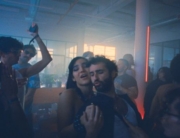
The second act—the film’s centerpiece—is also the shortest and essentially composed of a single extended dance sequence. And what a sequence it is. Chuck (Tom Hiddleston), impeccably dressed and seemingly healthy, is an accountant walking to a conference. Taylor (Taylor Gordon), a drummer, performs on a street corner, unsure if she’ll earn anything that sunny day. But Chuck stops. And listens. Taylor adjusts, picking up the rhythm. Chuck drops his suitcase and starts dancing. A crowd gathers. His virtuosic solo becomes a pas de deux when a young woman, Janice (Annalise Basso), whose boyfriend has just dumped her via text, feels compelled to join. What starts as improvisation turns into choreography—graceful, exuberant, and filled with flair. It’s the kind of cinematic magic that deserves to be seen on a big screen. It’s one of the best scenes from one of the best films of 2025 (the movie screened last year at the Toronto International Film Festival, where it won the People’s Choice Award).
How do you come down from such a peak? The third act—the longest and most substantial—centers on Chuck’s childhood and adolescence (played by Cody Flanagan, the director’s son, and Jacob Tremblay, respectively). After losing his parents in an accident, Chuck lives with his paternal grandparents, Albie Krantz (Mark Hamill) and Sarah Krantz (Mia Sara). His grandfather instills in him a love of numbers; his grandmother inspires a passion for music and dance. They dance in the kitchen while preparing lunch. In the afternoons, they watch old musicals on VHS (a joke lands effectively when Grandma covers his eyes during All That Jazz).
These two seemingly contradictory halves are part of the multitudes he contains—and many more he has yet to understand—as a devoted literature teacher (Samantha Sloyan) takes time to unpack the meaning behind Walt Whitman’s Song of Myself. More dancing and inspiring monologues follow, along with the mystery of a locked room Chuck isn’t allowed to enter. His grandfather refers to it as haunted during one of his drunken nights. Hamill gives one of the most remarkable performances of his career here, standing out in a wonderful ensemble where every role proves essential.
All the mysteries are eventually answered in a film full of meaningful details and symbolic connections across its three acts. But the value of Flanagan at his most sincere—channeling King at his most lucid—goes beyond the mechanics of a well-told story. The movie may invite easy praise as “life-affirming” or “uplifting,” but it deserves celebration for trusting that audiences can still approach cinema with wonder and an open heart. It’s a movie for those who dream—and let those silly dreams move them to dance. Or, more precisely, for the multitudes within us still eager to dream and dance above the cynical voices.
We’ll likely see more ambitious films this year, others more technically accomplished, some more politically urgent—but very few as precious or as genuinely moving. The Life of Chuck is special, unpretentious cinema. It doesn’t try to transform our lives or change the world—because it recognizes the limits and powerlessness of art to do so—and in part becomes a bittersweet tribute to that truth. (Chuck chooses a life of numbers, not dance, after all.) And yet, it’s a film that leaves you wanting to keep trying—for a better life, a different world.


Leave A Comment