
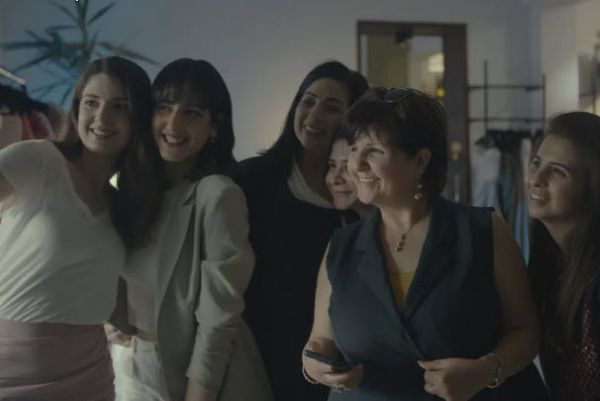
It can be easy to forget, when engaging with distant places mostly through horrifying headlines, that in some way, normal life persists everywhere. People maintain their everyday hopes, pursue their everyday aspirations, to the extent that circumstances allow. This is, partially, the subject of Scandar Copti’s engrossing Happy Holidays, which is set in modern-day Haifa, Israel and concerns a variety of interconnected characters. (It world premiered at the 2024 Venice Film Festival and was completed before the October 7, 2023, attacks.) The majority of them are Palestinian; a smaller selection is Israeli. They are alternately pursuing love affairs, working their way out of dire financial situations, figuring out whether to go through with pregnancies, and struggling to get through to family members who have grown distant. Yet, always, the outside world intervenes, and never in the same way twice.
Rami (Toufic Danial), a Palestinian man, discovers that he has gotten Shirley (Shani Dahari), an Israeli woman, pregnant. In spite of the problems this could cause in their more conservative families, she decides to keep the baby. When she receives aggressive threats on her phone from someone pretending to be Rami, the two of them are driven further apart. In another story, Rami’s mother, Hanan (Wafaa Aoun), struggles to bring her family out of dire financial straits—one way is to claim compensation for a car accident her college-age daughter Fifi (Manar Shehab) recently survived. In the third, Shirley’s sister, Miri (Meirav Memoresky), tries to convince her to have an abortion, knowing the father is Palestinian, as her own daughter begins to drift away from her for reasons she cannot discern. In the final chapter, Fifi falls in love with a man who works at the hospital, as well as trying to prevent her family from reading her medical records.
Each story is announced with a clever caption. However, the overall effect is certainly not tidy. Though we do see missing pieces of previous scenes, we are not always clear about where exactly we are in time. The point of view shifts have the effect of simultaneously revealing new ways the characters are interconnected and also upsetting our notions of what we thought was true, raising many more questions than are actually answered. The effect is not so much that of a deepening mystery, but instead, that of an ever-widening picture of the various forces that complicate their lives. Many of these forces, of course, involve the longstanding tension between Palestinians and Israelis, though Gaza is rarely mentioned outright.
Most of all, the film is beautifully and realistically acted, shot with understatement and a camera that follows its figures closely, and never raises to a melodramatic pitch. Politics are both ever-present and peripheral—an anti-Arab protest from the Kahanists (an Israeli terrorist group) is all too visible as Fifi and her friends walk around them on their way to a party. Fifi is an assistant at a kindergarten, where children are taught to praise the IDF, but she never speaks about this directly. Though all of the stories are riven by societal issues (attitudes to premarital sex, struggles to comply with Israel’s mandatory military service), the film never forgets those who are affected by them. All, we are led to understand, are trapped by a debilitating system and a violent history that they cannot break free of. Fascinatingly, one of the recurring themes is the desire some Palestinians and Israelis feel to coexist, in spite of all that is happening.
Happy Holidays is an assured, affecting, and invigorating film that, I’m guessing, is likely to hold up to repeated viewings. Its brave dedication to real-world complexity is worth the price of admission alone.

Leave A Comment