
Jaws is, in the eyes of many, a near-perfect movie, insofar as it accomplishes what it sets out to do, wastes no time doing it, and does all of this with consummate craftsmanship. Whether you buy into the deeper analyses of the film or think it’s simply a movie about a killer shark, the above is hard to argue with: The movie works. Nevertheless, I’m confident there is one audience for whom this film definitely would not work. Sharks. Because sharks don’t actually see humans as prey. This fact is widely documented—shark attacks are so rare that they happen to only one in 11.5 million people. Most of us are more likely to be struck by lightning. So, if a shark happened to see Jaws, its biggest issue might be a failure to identify with the apex predator on screen.
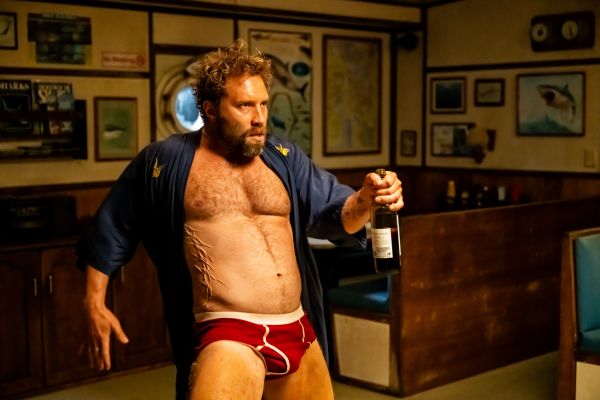
Sharks might fare better, however, with Sean Byrne’s Dangerous Animals. The real monster here isn’t a hungry fish haunting the ocean off the coast of Australia, but a man determined to manipulate these creatures for his own twisted ends. Tucker (Jai Courtney) is a big, burly boat owner with a barbed sense of humor and an outwardly friendly demeanor. Supposedly, he runs a business taking tourists out to swim with sharks.
What he actually does is kidnap young women, imprison them in a hideous cabin on his boat, and film them being bitten to death by sharks that he summons with blood and incites to violence. This is likely a deranged response to a near-death experience he had with the creatures as a child. Like any successful serial killer, he has his system down to a science. Like any true showman (and he does refer to his sadistic pastime as putting on a “show”), his greatest weakness is his craving for exhibitionism. That and the possibility that someone might spot the cracks in the illusion he creates.
One target, Zephyr (Hassie Harrison), is a young, footloose surfer who lives in her van. She’s excellent on the waves and a genuine loner—when she spends the night with a nice young man named Moses (Josh Heuston), she makes sure she’s gone by morning. (He texts her a picture of the breakfast he’s made for her, and she deletes the kind response she’s about to send.) Afraid of attachment and deeply devoted to the sea, she’s the perfect victim for Tucker: No one will miss her. Yet when he kidnaps her, he finds that she won’t submit to his plans so easily. Zephyr, it turns out, is a fighter.
The past decade has seen a sharp uptick in horror films with art-house aspirations. Dangerous Animals is not one of them. This movie, if it’s about anything, is about the ride it puts you on. It’s dedicated to near-miss escapes, jump scares, the grotesque methods of its villain, and the extremes its heroine must go to in order to survive. It’s about the one-liners that come just before someone gets stabbed or punched in the face. Some of it is definitely corny. (Why does Zephyr take to the sea? Because “there was nothing left for me on land.”) I won’t pretend this movie reinvents the wheel; I’m not convinced it will hold up to multiple viewings. Still, it’s a lot of fun and fresh enough to keep the viewer engaged. It accomplishes what it sets out to do with energy and pizzazz.
The film is wonderfully paced and imaginative in its action sequences, using the various materials of Tucker’s houseboat—harpoons, plates, hooks—to excellent effect. Some of the disturbing images (like part of a bloody corpse floating underwater) are striking and precise. The film leans into grotesquerie without ever drowning in it: This director understands the balancing act of keeping an audience’s hair raised.
Tucker is a strong villain, in part because his behavior is so ridiculous and unhinged (and played with enthusiasm and commitment by Courtney), but also because he’s sometimes pathetic—easily hurt and animalistic in a way that mixes fear and aggression. We see him calmly eating upstairs or dancing in his bathrobe while his victims suffer and scramble to escape below. That matter-of-fact quality, how undisturbed he seems by his own violence, heightens the tension and makes him feel specific and real.
And it’s hard not to root for Zephyr’s ferocity and her increasing ingenuity as she fights back. The film also includes a number of weird parallels that give it structure and coherence: Zephyr flees a man who kindly makes her breakfast, only to be kidnapped by a man who gives her what we might call “evil breakfast” (a piece of bread and a drugged drink). Zephyr is afraid of connection; Tucker, also a loner, forcibly drags others into his perverse need for control.
If the achievement is modest, the filmmakers’ enthusiasm is nevertheless infectious. And sharks—those misunderstood underwater creatures whom Tucker claims to know so well—do, in the end, get their say. You’ll have to watch the film to see just how.










Leave A Comment