
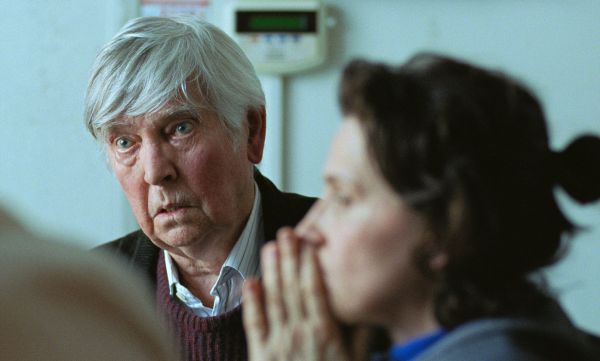
Queen at Sea is another offering in the fairly recent trend of films about dementia. Colin Firth and Stanley Tucci are lovers dealing with the beginning of the disease in the excellent Supernova. The Father, with Anthony Hopkins, took an artier turn on the subject. And now comes Queen at Sea from writer and director Lance Hammer, who last directed the indie Ballast, a drama set in Mississippi. Here he moves to London for the story of Amanda (Juliette Binoche); her mother, Leslie (Anna Calder-Marshall), who suffers from advanced dementia; and Martin (Tom Courtenay), her husband and main caretaker as well as Amanda’s stepfather.
The conflict begins when Amanda visits her mother and catches her stepfather having sex with her. Horrified that her mother isn’t able to consent, she confronts Martin, who insists she initiates it and he is her husband. He also doesn’t believe Leslie’s doctor’s admonition that her increased desire for sex is mainly symptomatic of her disease. Instead, he has read online geriatric psychologists who claim that sex is a comforter for those with dementia. Amanda calls the police in the hopes that this would get Martin to stop, but it backfires when the police file a report and call in social services.
What follows is a debate on what consent means to someone who is not fully cognizant, and who gets to decide what that person desires, particularly if that person isn’t able to communicate. The tug-of-war between Martin and Amanda demonstrates two different viewpoints based on their own experiences and their feelings about Leslie. Leslie generally looks bewildered at it all and is either very passive or very determined but, being an artist, only appears at peace when she is drawing.
An alternate storyline takes place as Amanda’s teen daughter Sara (Florence Hunt) begins a tentative relationship with a local boy, James (Cody Molko). The narrative toggles back and forth between the two, contrasting the openness and curiosity of youth with the anxieties and inevitability of adulthood and, of course, old age.
These are great bones for a solid story, and Hammer actually hammers his themes home quite well. It is beautifully shot, every frame meticulously composed, all set to wistful classical music, but it’s all frighteningly and stiflingly downbeat and depressing. The same could be said of The Father, but that drama, with all its flaws, had a thrumming heart. There is never a moment of levity—even in Michael Haneke’s film about aging, Amour, there is some humor, as dark as it may be. It also doesn’t really reflect the reality of caring for an older parent or partner in this, or any, long-term medical situation.
This dispassionate and cold movie strands fantastic performances by Binoche, Calder-Marshall, and especially Courtenay. His Martin is unabashedly romantic and optimistic, and the only one who demands Leslie deserves real attention and affection. Binoche’s Amanda is more complicated, with an ambivalent relationship to her stepfather, and, cleverly, it’s hard to suss out how close she ever was to her mother. It’s a shame, then, that the insistently bleak progression of Hammer’s script snuffs out any light.
Queen at Sea, while positioning itself as a classy art film, is really as disheartening and ultimately unrealistic as any nihilistic slasher flick.










Leave A Comment