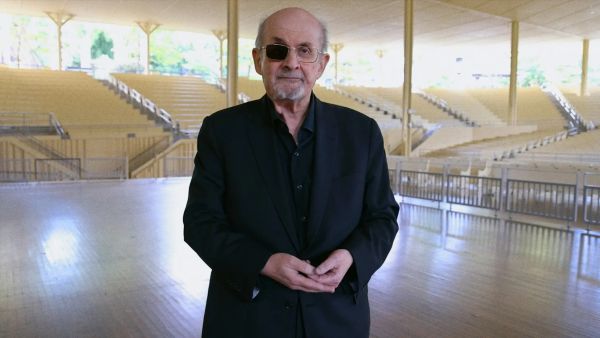
When Salman Rushdie was attacked by a knife-wielding assailant at the Chautauqua Institution in western New York State in the summer of 2022, it was the frightening culmination of a nearly 35-year saga during which the British-Indian author had a target on his back for the “crime” of writing a novel, The Satanic Verses, that inflamed parts of the Muslim community. In 1989, after the book was published, Iran’s Ayatollah Khomeini issued a fatwa, or death sentence, that anyone could fulfill. More than three decades later, someone tried.
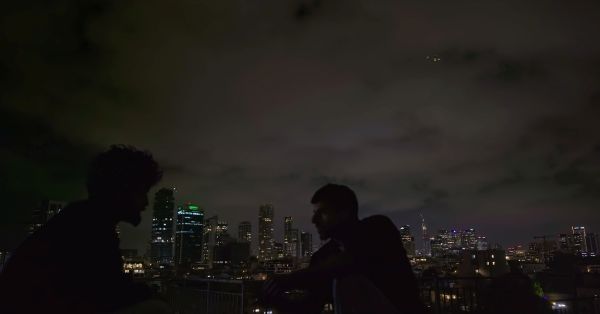
As Alex Gibney’s never less than riveting account of the attack and Rushdie’s recovery starts, a 24-year-old Muslim male from New Jersey—who took a bus to Chautauqua—calmly walks onstage as Rushdie begins a public lecture and begins stabbing him. Though Gibney begins with a shadowy re-creation, he shows the quite graphic footage of the actual attack several times throughout, and it is never less than shocking each time.
Gibney had the good fortune to have access to footage of the attack’s aftermath and Rushdie’s slow recovery in the hospital shot by Rushdie’s wife, American poet Rachel Eliza Griffiths, whom he married the previous year. Griffiths’s footage is frank and disturbing, detailing her husband’s horrific injuries—he was stabbed in the right eye, which he ended up losing sight in; his left hand, which he temporarily lost the use of; and his right cheek, among many other wounds—and the treatments he underwent. Poignant conversations between the couple are captured, as well as an angry and tearful Griffiths filming herself commenting on the attack as he lies asleep nearby.
With Rushdie himself narrating—several of the passages come out of his 2024 memoir, Knife: Meditations After an Attempted Murder—Gibney recounts the fateful history of the fatwa against Rushdie, which included attacks on book publishers and newspapers that dared to defend the novelist, along with his Japanese translator, who was murdered in cold blood. The infamy of The Satanic Verses made Rushdie a household name, but he was forced to hide out in various safe houses throughout London for several years. Rushdie admitted to Morley Safer in a 60 Minutes interview that it was no way to live, and he eventually moved to New York City, where he reveled in a high-profile social life, making the gossip pages when he married model-turned-TV host Padma Lakshmi. “I achieved freedom by living like a freeman,” he says in voice-over, later realizing the danger it may have caused: “Have I made myself available for the knife?”
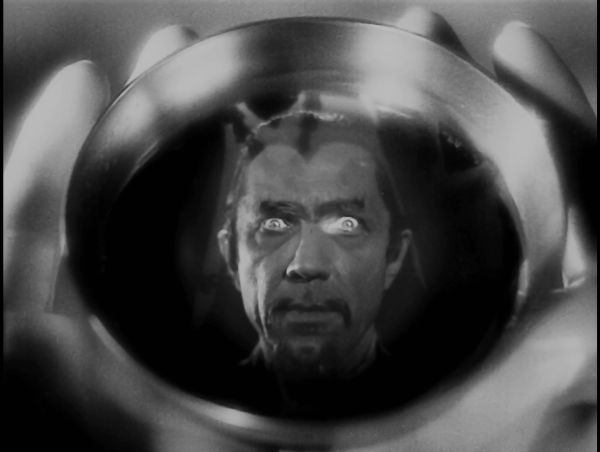
Some of the most memorable moments occur when Rushdie recounts his memories of the attack’s aftermath, including tying what happened to films that he loves. Indeed, he says that, during his first night in the hospital, he dreamed the famous sequence in Bergman’s The Seventh Seal of the knight facing off in a chess match with Death. Other clips include Polanski’s Knife in the Water, the knife fight in West Side Story, and the infamous shower scene from Hitchcock’s Psycho. Rushdie even references two indelible images from silent classics: the space capsule that landed in the moon’s right eye in Georges Méliès’s A Trip to the Moon and a razor slitting an eye in Buñuel and Dalí’s Un Chien Andalou.
Most fascinatingly, Rushdie says about his assailant that he refused to name him in the Knife memoir, instead amusingly shortening “assailant” to “ass.” Later he decides to simply call him “the A.” When the A. is convicted and given a life sentence, Rushdie returns to the town of Chautauqua a year after the crime, visiting the prison where the A. is being held. We see a photo of him standing outside the prison fence and grinning, while he defiantly says that, unlike the A., “my life will go on.” On the evidence of Gibney’s documentary along with the publication of a collection of Rushdie’s latest short fiction, it certainly has.


Leave A Comment