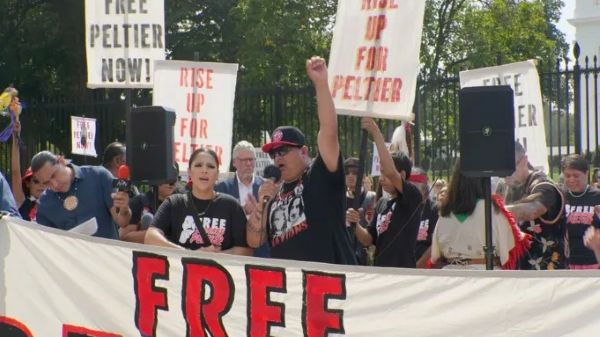
Has there ever been a social justice documentary expressly made to help free a political prisoner where, before the film is released, the prisoner is freed? That is the remarkable case with Free Leonard Peltier, about the efforts to, you guessed it, free Peltier. Jesse Short Bull and David France’s documentary provides a detailed history of the activist, who was imprisoned for nearly 50 years before finally having his sentence commuted to indefinite house arrest by President Biden in January 2025, and the civil rights group he was part of, the American Indian Movement. Peltier is, as described here, the Nelson Mandela of the American Indian Movement (and even of the country in general), so learning about him is essential to understanding U.S. history.
The best thing here is the copious archival footage from the crucial period of the early 1970s. AIM’s activities were remarkably well documented. We witness the progression of the group’s activism, from the occupation of Alcatraz Island from 1969 to 1971 to the occupation of the Bureau of Indian Affairs in Washington, DC, in 1972, to the climactic standoff in 1975 in Pine Ridge, South Dakota, between AIM and the FBI, which led to Peltier’s imprisonment.
When he was nine years old, Peltier was taken forcibly to boarding school by the BIA, where he had his hair cut, was stripped naked, and sprayed with DDT. In an early interview from the 1970s, Peltier describes this traumatic experience and details how adolescents were punched and kicked by adults in these boarding schools. The BIA had control of Indian lives, the goal being to assimilate them, forcing them to imitate White American culture.
The BIA occupation was one of Peltier’s first forays into activism, where he was, in his words, targeted by FBI agents and police officers who were assigned to provoke and arrest AIM leaders.
The 1975 Pine Ridge incident was complex and violent, amounting to a civil war between AIM activists and the Oglala tribal government, led by Dick Wilson, who collaborated with the FBI. Wilson formed what he called his GOON squad (Guardians of the Oglala Nation), which became a paramilitary force fighting against AIM; GOON was given high-powered guns, with armor-piercing rounds, by the FBI.
Into this civil war arrived two FBI agents, who were caught in the crossfire and killed. Two AIM members, Bob Robideau and Dino Butler, were tried for the murders, but found not guilty, as their actions were deemed to have been in self-defense. Peltier, who was hiding in Canada, was then extradited to America to stand trial, and the FBI acted to make sure he had a less than sympathetic judge at his trial. He was duly found guilty and sentenced to two consecutive life sentences for a crime he maintained, for decades, that he did not commit.
As a history of complex political and legal affairs, the film is effective, immersive, and highly informative. One problem is that, as mentioned above, the documentary was intended as a vehicle to lobby for Peltier’s release. He was actually released, to house arrest, shortly after the film’s premiere because of a last-minute commutation of his sentence by President Biden in January 2025. Thus, a good deal of the running time concerning relitigating his trial and examining the evidence in minute detail, especially surrounding the alleged murder weapon, is no longer relevant. As a result, some viewers may find themselves bogged down in the complexity.
Another possible criticism is the use of AI to reenact the shootout. I was impressed by the detail and production value in these scenes, and only while watching the end credits and seeing a disclaimer about the use of generative AI did I realize that these were AI generated. For a social justice film probably lacking a huge budget but having big ambitions, I don’t see a big problem in using AI in this specific way.




Leave A Comment