
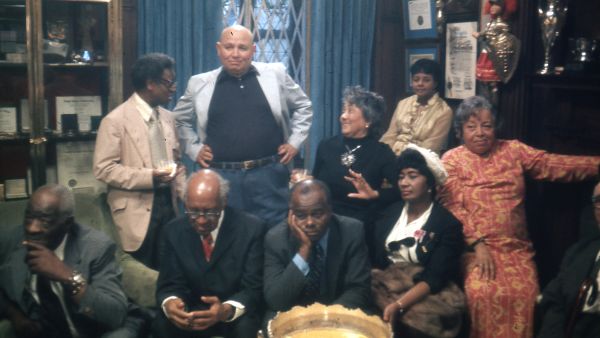
In 1972, legendary filmmaker William Greaves (perhaps best known for his experimental Symbiopsychotaxiplasm works) assembled and recorded a group of surviving members of the Harlem Renaissance to gather for a party at Duke Ellington’s former Harlem townhouse. Greaves long considered the footage he shot there one of his most important works. However, he had set the project aside to work on other films and passed away in 2014; his wife, Louise, shepherded the project up until her death in 2023. Louise entrusted William’s granddaughter Liani, credited here as co-producer, to take over the project. William’s son, David Greaves, listed as the documentary’s director, was one of the four original camerapersons on the project. Hours of footage were shot, according to recent interviews, on 60,000 feet of 16mm film, every frame of which was digitized.
David Greaves and editors Anne de Mare and Lynn True magically and digitally whittled the film down to 100 minutes. (One wonders about all the difficult decisions that were made in the cutting process.) The look and feel of the documentary remain rich and intoxicating and become meta, in a way, as its subjects pay tribute to people from the past, just as this archival footage becomes a multi-generational document of tribute to the past as well.
With all its references, chatter, and detail, the film is almost overwhelming at first, but if one just lets the picture wash over them, it quickly finds its groove. Captions are smartly repeated for each of the guests to remind us of who is who. Just a few of the luminaries include artist Romare Bearden; writer Arna Bontemps; musician Eubie Blake, who co-wrote the landmark Black Broadway musical Shuffle Along; writer and painter Richard Bruce Nugent (one of the more charismatic, electric presences); and actor Leigh Whipper (96 years old, and who would pass away a few years later).
The debates within the group are lively and respectful, and disagreements are often ameliorated by humor. They even argue about when the Harlem Renaissance was. Ida Mae Cullen, poet Countee Cullen’s widow, notes that it was only in the 1920s, but others track it earlier, starting in the 1910s. The group often talks about certain individuals and legendary artists of the time who have since passed, such as modernist writers Zora Neale Hurston and Langston Hughes, pondering their legacies. There are even some friendly disagreements and tensions over who the most significant Harlem Renaissance figures were. Cullen stands up fervently to preserve the writing and legacy of her late husband. She also movingly addresses William himself directly behind the camera and the indispensable work he is achieving in gathering everyone together and in the making of the film.
It is enlightening to see and hear from some of the behind-the-scenes participants as well, whose names may not be as familiar to some. By creating space in the library in which she worked and providing a salon at her home, Regina Andrews emerges as an instrumental figure who helped develop writers and artists. The horrors of history are recalled as well, including the lynchings and violence of the East St. Louis riots. The present-day issues of 1972 surface too: There is some back and forth about the usage of the word Black versus Negro. There also seems to be a prevailing sense among them that the youth of this era do not have respect for, nor an understanding of, history, and that it is all about the now for the younger generation.
Greaves’s idea to use four cameras was smart, giving the project a multi-dimensional feel and a way to capture different stories in different rooms simultaneously. The final result is a smooth, beautifully assembled work, sometimes utilizing split screen as a way to capture the listeners and the speakers, as well as archival photographs and texts of poems. The emphasis on the vitality of history is always relevant, and remains especially pertinent now, when history is under attack. Essentially, Once Upon a Time in Harlem is an illuminating documentary, and also one of the great hang-out films. It is humbling to sit in its rooms for 100 minutes alongside such sparkling intellect.



Leave A Comment