
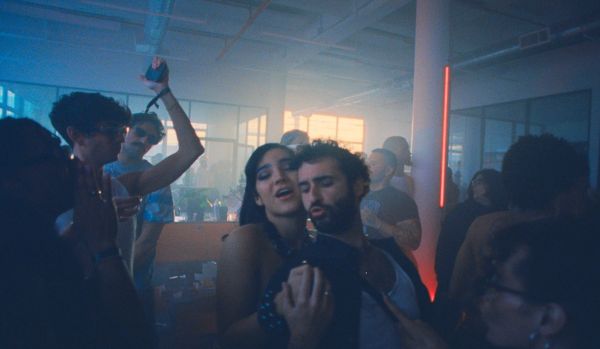
Jordan Firstman’s debut directorial feature is an earnest, spirited, energetic comedy set within an edgy milieu. It took me back to classically structured fish-out-of-water yarns of the late 1970s and early 1980s, like Kramer vs. Kramer, Tootsie, and Baby Boom. In Club Kid, a New York City party promoter, Peter (Firstman), learns he has a 10-year-old son, Arlo (Reggie Absolom), born out of a drug-fueled, hasty hookup, and is suddenly his guardian.
Often incorporating screwball comedy with wistful undertones, the film is edited with zip by Taylor Levy and Sofía Subercaseaux. It is particularly dizzying from the outset, beginning in 2016 with a gaggle of club kids packed in an Uber, including Peter—in a crystal-studded Madonna “Music” T-shirt—singing along to Rihanna’s “Sex with Me.” They are wild, loud, and obnoxious (the Uber driver is visibly irritated). The group dances, parties, and does drugs into the wee hours. Peter, who is gay, has a rash, druggy hookup with a persistent British woman, Leonora (Paris Petitjean), who has been pursuing him all night alongside Edison (Kirby Howell-Baptiste).
The film then jumps to the present day: Peter is still living it up, but he’s gotten older, and the hangovers are hitting hard. He lives in his late mother’s apartment in Dimes Square—an area between Chinatown and the Lower East Side—with a quirky roommate, the unemployed Nicky (Eldar Isgandarov), and he doesn’t seem to be making much progress finding a job from the couch. (Isgandarov, a memorable presence in this small role, also shows up in another comedy at the New York Film Festival, The Debut.) Suddenly, to Peter’s complete shock, Leonora’s friend Edison appears with 10-year-old Arlo in tow. After all these years, Peter barely remembers who Edison and Leonora even are. Leonora has recently died, and Edison has brought Arlo from London. Edison dashes out of the apartment and disappears; it’s obvious that she has abandoned Arlo to leave him with his father, though it takes a while in his druggy stupor for Peter to realize the situation: He’s now stuck with his kid and must navigate balancing his party life—and perhaps changing it—while suddenly playing the role of a father.
It may seem like a predictable story on paper, but Firstman’s film is consistently surprising, especially when dealing with Peter’s run-ins with an array of eccentric characters brought to life by vivacious, authentic performances from multi-hyphenate artists with few film credits, such as Saturn Risin9, Alaska Riley, and Miss Benny. His downstairs neighbor, the batty rent-controlled tenant caricature, Evelyn, is a hoot, played with glee by Colleen Camp—always a pleasing, idiosyncratic presence. (The film even has a brief Election Easter egg moment.) Cara Delevingne is nervy and alive in the role of Sophie—another party promoter with whom Peter has a falling out—and provides the plot with wide-eyed, cocaine-fueled acts of mischief. Additionally, Diego Calva’s Oscar plays a social worker and a potential love interest for Peter. The movie harnesses the on-location specificity and energy of some of Sean Baker’s work in its kinetic style, as well as in its mixing of professional and non-professional actors.
In Sebastián Silva’s Rotting in the Sun, Firstman played an exaggerated version of himself as a social media influencer. Here, he shows range in an impressive, layered turn that is both broad and intimate, reminiscent of Dustin Hoffman in those aforementioned movies. In a sense, too, with Firstman in front of and behind the camera, Club Kid’s refreshingly unburdened portrayal of sex, drug use, and queerness feels like it could potentially be emblematic of a dramatic generational shift in the way The Graduate was.
Still, the movie isn’t particularly groundbreaking in its narrative, relying on some admittedly comforting comedy tropes. If Arlo weren’t so docile and charming, with exquisite music taste (there’s a laugh line when he tells Peter he’s a fan of the Cocteau Twins), Peter would probably abandon him. Both Firstman and Absolom, through interactions that never feel false, play well off each other, developing a sweet and believable bond. A piano scene between the two—shot similarly to Jill Clayburgh and Lisa Lucas as mother and daughter at the piano, belting out “Maybe I’m Amazed” in An Unmarried Woman—is utterly moving.
Somehow Club Kid sustains its great energy as its protagonist’s journey unfurls. When the film takes a more sobering turn in the latter half, suddenly quieting down, I was jolted—aware of how long I’d been under the film’s spell and in suspense over what would happen next.
In the United States, Club Kid will be released via A24 on November 6.









Leave A Comment